
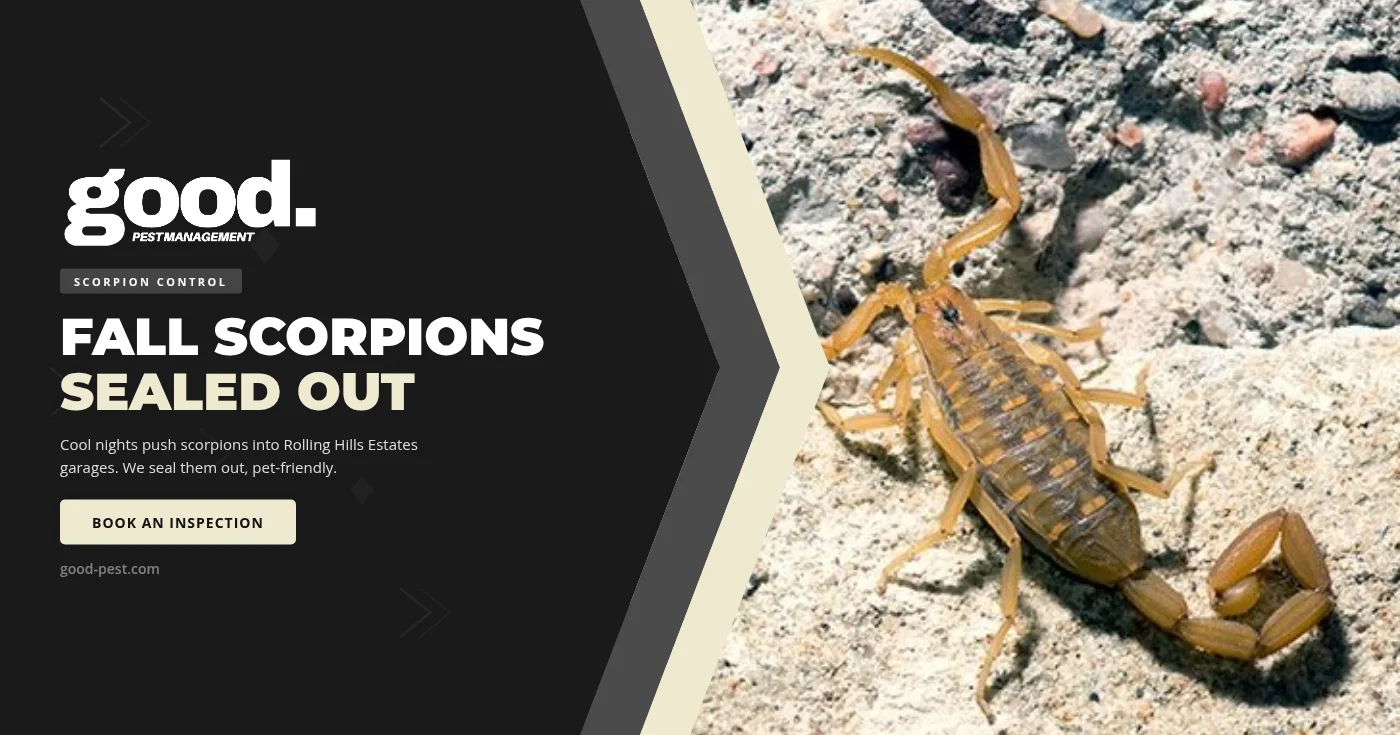
The first cool November evening on the hill often brings an unwelcome surprise: a pale, crab-clawed visitor skittering across the garage floor, or one tucked under a log you just carried in for the fireplace. If you’ve been searching for scorpion control Rolling Hills Estates homeowners can count on, you’re in good company. Fall scorpion activity is one of the most common concerns we hear from canyon-side properties this time of year.
Here at Good Pest Management, we serve neighborhoods across the South Bay, and the hillside streets of Rolling Hills Estates are some of the most scorpion-friendly terrain we visit. Coastal sage scrub, horse trails, rock walls and quiet canyons give these native arachnids plenty of room to roam. When nights cool, some go looking for a warmer, drier spot, and that spot is often your garage.
Below, we explain why scorpions move closer to homes in fall, how to recognize them, where they hide on hillside properties, what draws them in and how to seal them out before winter. We’ll also walk through how our pet-friendly, eco-friendly approach works when do-it-yourself steps aren’t enough.
Scorpions are nighttime hunters. During the day they hide under rocks, boards, loose bark, debris and woodpiles. According to UC IPM’s Pest Notes on scorpions, they usually wander indoors by accident while looking for shelter, moisture or food. They don’t set out to move in with you, but fall conditions make your home look awfully appealing.
On the Palos Verdes Peninsula, November is typically when the weather turns. Nights often dip into the high 40s or low 50s while days stay mild. We can’t point to a study proving that cooler nights alone drive scorpions toward houses, but what we see in the field fits a reasonable explanation: garages, stucco walls, concrete slabs and stacked firewood hold the day’s warmth and stay dry long after the hillside brush has chilled.
The season’s first rains, which often arrive around now, likely add to the push. Water can flood the burrows where scorpions shelter, along with the crickets and beetles they feed on. Displaced prey heads toward drier ground near foundations, and scorpions follow.
Fireplace season plays a part, too. Carrying in wood that sat against a fence all summer is one of the easiest ways to bring a scorpion straight into the living room. And while scorpions slow down in cold weather, they don’t vanish. In a garage that stays relatively warm, they can remain active all winter.
Palos Verdes Peninsula scorpions are native Southern California species, and a confirmed, peninsula-specific species list is surprisingly hard to pin down. Rather than guess at scientific names, we’d rather help you recognize what you’re looking at. Most scorpions we encounter locally share a few traits:
Many homeowners worry about the Arizona bark scorpion, the species with the most serious reputation in the Southwest. Based on UC IPM’s guidance, it lives mainly in Arizona and along the Colorado River, and it isn’t known to be established on the peninsula. Locally, a sting typically feels similar to a bee or wasp sting: pain, swelling and some numbness. Young children, older adults and anyone with allergies should still get medical advice after a sting, and pet owners should call their veterinarian.
One identification trick surprises people: scorpions glow blue-green under ultraviolet light. A handheld blacklight and a slow walk around the garage, patio and walls after dark can reveal how many are really around.
The features that make hillside living so appealing also create ideal scorpion habitat. These are the places we check first.
Finding scorpions in your garage is the classic fall complaint. Garages hold heat, often have worn door seals and fill up with cardboard boxes and floor clutter, exactly the dark, undisturbed cover scorpions want. Even a narrow gap under the main door can let one slip in.
Firewood stacked against the house, lumber piles, leaf litter and stacked pots give scorpions shelter right beside your foundation. The closer the cover is to your walls, the shorter the trip indoors.
Block walls, stacked stone and retaining walls are full of crevices that stay warm and dry. Weep holes and mortar gaps act like apartment units for scorpions and the insects they hunt.
Stables, tack rooms, hay storage and split-rail fencing are part of the local character, and they attract crickets, beetles and other insects. Where prey gathers, scorpions follow. Keeping hay and feed off the ground, clearing manure regularly and limiting debris near barns makes a real difference.
Scorpions are predators. They feed on insects and other arthropods, including crickets, cockroaches, spiders and silverfish. If your home or yard is a reliable buffet, scorpions have every reason to stick around.
That’s why we treat scorpion problems as part of the bigger picture. A garage full of crickets in fall is practically an invitation, and a steady population of spiders in the eaves means food for scorpions, too. Our spider pest control and cockroach pest control services help cut off that food supply, and reducing silverfish in damp areas helps as well.
Prey control matters for another reason: UC IPM notes that scorpions can go weeks or even months without eating, so a one-time spray rarely solves the problem. Shrinking the food supply makes your property less attractive over the long run.
A few quick ways to reduce prey around your home:
Scorpion exclusion, or physically blocking the ways in, is the most effective long-term step you can take. Scorpions flatten themselves to squeeze through narrow cracks, so the goal is to close as many openings as possible before the coldest weeks arrive.
Install door sweeps on exterior doors and on the door between the garage and house. Check the rubber seal along the bottom of the garage door; if you can see daylight, so can a scorpion. Replace worn weatherstripping around frames.
Many local homes have stucco walls finished with a metal weep screed at the base. It lets moisture escape, but the gap behind it can also be an entry point. Screening the right sections without blocking drainage is worth getting right, and we help with it during exclusion work.
Store firewood off the ground and away from the house, and knock each piece before bringing it inside. In the garage, swap cardboard boxes for sealed plastic bins and keep items off the floor. Shake out shoes, gloves and blankets that have sat in storage.
Do-it-yourself steps help, but properties with canyons, rock walls and barns often need a more thorough plan. Here at Good Pest Management, we rely on inspection, exclusion and targeted, pet-friendly scorpion treatment rather than blanket spraying.
Because scorpions can hide for long stretches, many homeowners choose recurring service, which is fully warrantied between scheduled visits: if pests return, so do we. We’re licensed and insured, known for quick communication and fast touch-up response, and same-day inspections are often available. Every visit is backed by our 100% satisfaction guarantee.
For most people, a local scorpion sting is painful but similar to a bee or wasp sting, according to UC IPM. Reactions vary, though. Young children, older adults and anyone with allergies should get medical advice promptly, and if a dog or cat is stung, call your veterinarian. The best protection is keeping scorpions out of the spaces where kids and pets play.
Garages hold warmth, stay dry and are often full of clutter, all things scorpions seek as nights cool and early rains disturb their hillside burrows. Worn door seals make it easy for them to wander in.
Yes. Scorpions glow under ultraviolet light, so a nighttime walk with a UV flashlight is a simple way to spot them along walls, in garages and around woodpiles. It won’t remove them, but it shows where they’re gathering.
Usually not on its own. Scorpions spend much of their time hidden and can go long periods without eating, so sprays alone tend to have limited results. Sealing entry points, reducing clutter and cutting off their food supply make lasting progress.
Cooler nights, first rains and warm garages make November prime time for scorpions to move closer to hillside homes. A few smart steps go a long way, and you don’t have to tackle it alone when you need dependable scorpion control in Rolling Hills Estates.
Good Pest Management started in 2024 with zero customers and a lot of door knocking, and in about two years we’ve grown to over 2,000 customers across Torrance, the South Bay, the Palos Verdes Peninsula and the greater Los Angeles area. We’re local, licensed and committed to friendly, professional, eco-friendly service. Contact us today to schedule your scorpion inspection and enjoy the cooler months without uninvited guests. Good Pest, bad news for bugs.
When November nights cool down, scorpions living in canyon brush and rock walls start looking for warm, dry shelter, and garages, woodpiles and stucco walls are at the top of their list. We see it every fall on hillside properties, and we know how unsettling it is to find one near your shoes or your kids’ toys.
Here at Good Pest Management, we focus on keeping scorpions out for good, not just spraying what you can see. Our approach includes:
We’re licensed and insured, we communicate quickly, and same-day inspections are often available. Our recurring service is fully warrantied between scheduled visits, and every job comes with our 100% satisfaction guarantee, so you can enjoy peace of mind all season.
Want to know why scorpions move indoors as the weather turns, how to identify them and the sealing steps you can take before winter? Read our full guide to fall scorpions and how to seal them out.