
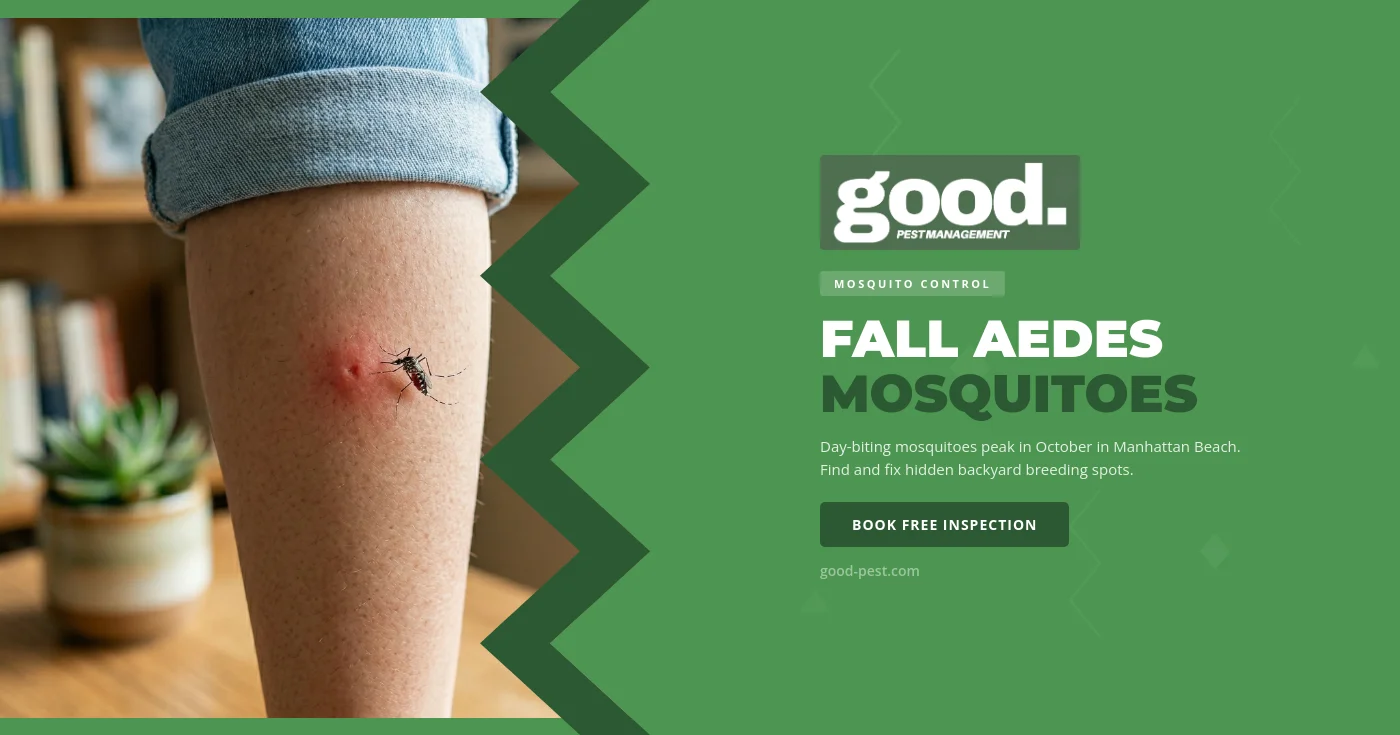
If you’ve stepped onto your patio on a warm October afternoon and walked away with itchy welts around your ankles, you’re not imagining things. Mosquito control in Manhattan Beach doesn’t stop when summer ends, because the small, striped day-biters behind those bites often hit their stride in early fall.
These pests are invasive Aedes mosquitoes, and the species acts nothing like the evening mosquitoes most Southern California families grew up with. It bites in broad daylight, hides under patio furniture and breeds in water so small most people never notice it. Here at Good Pest Management, we hear from homeowners every fall who are surprised that the bites get worse, not better, as the weather turns.
In this post, we’ll explain why the fall mosquito season in the South Bay runs so late, how to recognize the Aedes “ankle-biter,” where it breeds around coastal homes, and a simple weekly routine that makes a real difference. We’ll also cover when to call a licensed professional and how our pet-friendly mosquito treatment works.
Many people assume mosquitoes vanish once school starts. In coastal Southern California, that’s rarely true. Vector control agencies across Los Angeles County generally report that invasive Aedes numbers tend to climb through late summer and can stay high into October and even November. Local data on the exact timing of a peak in individual cities is limited, so it’s best to think of this as a regional pattern rather than a precise calendar.
A few things work together this time of year. Fall often brings a “second summer,” with warm spells and dry Santa Ana conditions that speed up the mosquito life cycle. Near the coast, mild nights mean adult mosquitoes keep flying well into the season. And because most yards are still on regular sprinkler schedules, saucers, drains and low spots stay wet even when it hasn’t rained in months.
Then there are the seasonal extras: Halloween decorations that collect water, rain barrels set up ahead of winter, and early-season storms that refill every forgotten bucket and toy in the yard. Each of these can become a nursery for the next generation, which is why bites can feel worse in October than in July.
According to the California Department of Public Health’s Aedes detection table, Aedes aegypti — often called the yellow fever mosquito — has been detected in the city, while the Asian tiger mosquito (Aedes albopictus) has not been reported there as of the most recent update. The list changes often, so it’s worth checking for the latest status.
Aedes aegypti is small and dark, with white bands on its legs and a lyre-shaped pattern on its back. Unlike native mosquitoes that come out mostly at dusk, this species is generally a day-biter, most active in the early morning and late afternoon. It prefers to stay low, which is why ankles and lower legs take the brunt of it, and it often hides in shady spots under tables, chairs and dense plants.
Beyond the itchy bites, Aedes aegypti is capable of carrying viruses such as dengue, Zika and chikungunya in parts of the world where those diseases are common. California has reportedly seen only a small number of locally acquired dengue cases in recent years, and the overall risk here is considered low. Still, reducing breeding around your home is the best way to keep this mosquito from settling into your neighborhood. For health guidance, the LA County Department of Public Health and your local vector control district are the best sources.
Here’s the part that surprises most homeowners: you don’t need a pool or pond to have a mosquito problem. Aedes aegypti lays eggs just above the waterline in small containers, and a bottle cap’s worth of water may be enough. Because adults generally fly only a few hundred feet, the mosquitoes biting you most likely grew up on your property or right next door.
Tight lots, lush landscaping and lots of outdoor living space are part of beach-city charm, but those same features create dozens of tiny water sources. Side yards, utility boxes, outdoor showers, surfboard racks and drip trays under potted citrus are all worth a look. If you share a fence with a neighbor, a quick conversation about containers on both sides can go a long way.
Because Aedes eggs can survive dry for months, simply dumping water isn’t always enough. The eggs stick to the inside walls of a container and hatch as soon as water returns. A consistent weekly routine breaks that cycle, and the whole walk-through usually takes just a few minutes.
Pair the routine with personal protection. An EPA-registered repellent containing DEET, picaridin or oil of lemon eucalyptus, used according to the label, generally offers far more protection than citronella candles, bug zappers or smartphone apps, which do little against these day-biting mosquitoes.
A good tip-and-toss habit solves a lot, but some properties need more help. Consider calling a professional if:
It’s also worth knowing that the Los Angeles County West Vector Control District is generally the public agency covering this part of the coast. Residents can typically report day-biting mosquitoes and may be able to request an inspection, and we encourage those reports because they help track invasive species across the region.
Here at Good Pest Management, we work alongside those public efforts on the private-property side, inspecting every corner of your yard and treating the spots DIY can’t reach. Fall is busy for other outdoor pests too, so we often handle webs and egg sacs with spider pest control and foundation trails with ant pest control during the same visit.
Our goal is to knock back the mosquitoes you have now and make your yard far less inviting to the next wave, using a targeted approach rather than blanket spraying.
We start by walking your property, identifying breeding sites, resting areas and water sources you may have missed. Inspections are free, and we pride ourselves on quick scheduling and fast communication.
We help remove or correct breeding sources first. For water that can’t be drained, such as certain drains or catch basins, and for the shady foliage where adult mosquitoes rest, we apply EPA-registered products according to their labels, focusing only on the areas that need it.
Because Aedes populations rebound quickly, recurring service tends to work best through the fall mosquito season in the South Bay. Each visit includes a fresh check for new containers and follow-up treatment where needed.
Our eco-friendly mosquito control is built with families and pets in mind. We choose pet-friendly options, explain exactly where we’ve treated, and let you know how long to keep pets and children off treated areas until everything has dried. As a licensed, insured company and NPMA member, we back every service with our 100% satisfaction guarantee.
Daytime bites at ankle level are a classic sign of Aedes aegypti, which has been detected locally. Unlike native evening mosquitoes, this species bites mainly in daylight, especially in the morning and late afternoon.
Yes. Warm fall weather, mild coastal nights and ongoing irrigation can keep invasive Aedes active through October and often into November. Activity usually tapers off as temperatures drop, though the exact timing varies from year to year.
Not always. Aedes eggs cling to container walls just above the waterline and can survive dry for months. Scrubbing the inside of saucers, bowls and buckets is what removes them.
Yes. The water held in bromeliad leaf cups is an ideal spot for Aedes larvae. Flush the plants weekly with a hose, or consider varieties that don’t hold water.
We use pet-friendly products applied according to label directions and give clear instructions on when pets and kids can return to treated areas. If you have specific concerns, just ask, and we’ll walk you through our plan before we start.
Invasive Aedes mosquitoes are a real fall nuisance for coastal homes, but a weekly tip-and-scrub routine, combined with professional help when needed, can make a big difference. Here at Good Pest Management, we’re a local, licensed team that has been providing pest control in Torrance and the South Bay since 2024, serving neighborhoods across the greater Los Angeles area.
If day-biters are keeping you indoors, contact us for a free inspection. We’ll find the hidden containers, treat what needs treating and help you enjoy a pest free life, all backed by our satisfaction guarantee. Friendly, professional mosquito control in Manhattan Beach is just a quick message away, so ask about our discount this season too!
Yes, and fall is exactly when we hear about them most. The tiny, striped mosquitoes biting your ankles in the middle of the afternoon are most likely invasive Aedes mosquitoes, and the California Department of Public Health has reported Aedes aegypti in Manhattan Beach. These day-biters breed in tiny pockets of water and tend to stay active well into October across the South Bay.
Here at Good Pest Management, we make mosquito control simple:
We also share practical tips you can use between visits, like a weekly tip, scrub and toss routine that removes eggs clinging to container walls. Combined with recurring service, that routine helps keep your patio comfortable through the rest of the season.
Want the full story on why these mosquitoes peak in fall and where they hide around coastal homes? Read our complete guide to fall Aedes mosquitoes, then reach out when you’re ready for a free inspection. We’re here to help you enjoy a pest free life.