
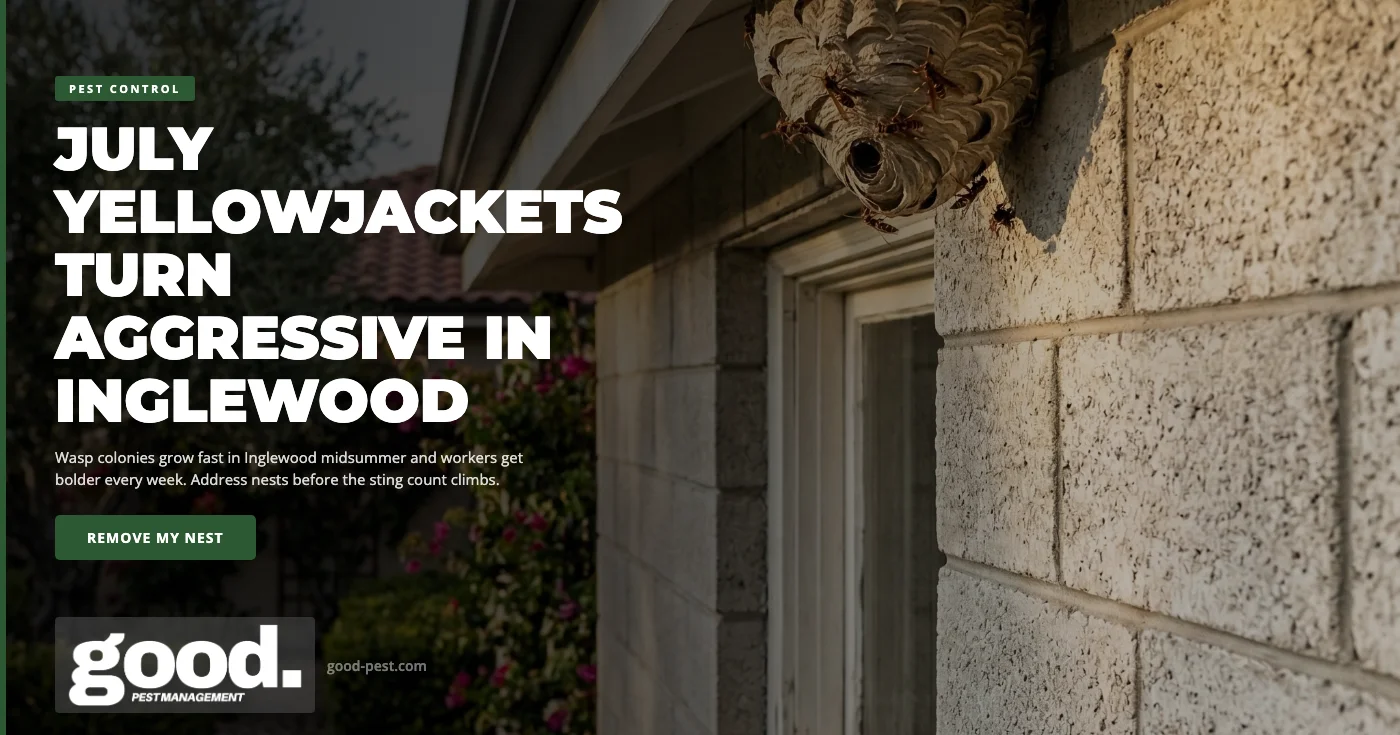
If you have noticed more wasps buzzing around your Inglewood, CA home this month, you are not imagining it. Every July, yellowjacket colonies across the South Bay hit a growth surge that puts them on a collision course with backyard barbecues, patios, and pool parties. At Good Pest Management, we handle wasp emergencies across Inglewood every summer, and this guide explains what is happening in July, what to watch for, and when to call a licensed professional for wasp control in Inglewood, CA.
Yellowjacket colonies in Southern California begin in early spring when a single overwintering queen builds a small paper nest and lays her first eggs. By mid-July, that quiet founding phase is over. According to the University of California Statewide Integrated Pest Management Program, colonies grow rapidly through late spring and midsummer, with worker populations climbing into the thousands. In Inglewood specifically, our warm, dry summers and steady food supply from parks, backyards, and food waste give colonies an ideal runway.
As populations swell, foraging workers spread out farther from the nest, so residents suddenly notice wasps everywhere. At the same time, wasps grow more protective of their expanding nest. A person walking near a hidden ground entry, a landscaper trimming a hedge, or a child kicking a soccer ball into the wrong bush can trigger a defensive swarm. Colony defense escalates further through August and September, but July is when we see the biggest jump in complaint calls and stings. If you have already spotted a nest or repeated wasp traffic in your yard, do not wait for late summer — the risk climbs every week.
Not every wasp buzzing around your Inglewood backyard is a yellowjacket, and knowing the difference helps our team recommend the right treatment. Three species drive most of the calls we handle across the South Bay.
Western yellowjacket (Vespula pensylvanica). The classic ground-nesting yellowjacket, black with bright yellow bands, about half an inch long. Colonies are large and highly defensive, especially around underground entry holes in flower beds and lawns.
German yellowjacket (Vespula germanica). An introduced species that has established itself across Los Angeles County and prefers to nest inside walls, attics, and roof cavities. UC Riverside identifies this species as the most common structural nester in urban Southern California, and Inglewood's dense residential neighborhoods are a favorite spot.
European paper wasp (Polistes dominula). Narrower body, orange-tipped antennae, dangling legs during flight. Nests are open, umbrella-shaped combs stuck under eaves, patio covers, and utility boxes. Paper wasps are less aggressive than yellowjackets but sting readily when a nest is disturbed.
Homeowners sometimes confuse yellowjackets with honey bees. Honey bees are fuzzy and rounder; yellowjackets have a smooth, waxy sheen and a distinct pinched waist. This matters because we protect pollinators — we relocate or refer honey bee swarms rather than treat them. When our technician arrives at your property, one of the first things we do is confirm the species so treatment matches the actual pest.
Yellowjacket nests are almost always hidden, and finding them is half the battle. In Inglewood, we see nests in the same handful of spots year after year.
Ground burrows. Western yellowjackets often take over abandoned rodent tunnels in flower beds, under retaining walls, and along fence lines. The entry looks like a small round hole with a steady stream of wasps entering and leaving.
Wall voids and attics. German yellowjackets in South Bay neighborhoods love the cavities behind stucco, around eave vents, and inside attic soffits. A tiny gap around a light fixture, weep screed, or vent screen is enough of an entry point.
Under decking and pool equipment. The shady, sheltered space under a wooden deck or beside a pool pump housing gives colonies protection from Inglewood's afternoon sun.
Utility boxes and irrigation covers. Buried valve boxes, meter enclosures, and lighting housings are popular hidden sites we check on every inspection.
Detached garages and sheds. Older Inglewood garages with warped siding or missing corner trim give both yellowjackets and paper wasps easy access.
If you have a dog that suddenly refuses to walk near a certain flower bed, that is a warning our technicians take seriously — pets often pick up on wasp activity before people do. Mapping the nest location is the first job for any professional treatment; treating in the wrong spot only stirs up a hidden colony.
A large yellowjacket colony rarely announces itself until someone walks too close. Watch for these earlier warning signs so you can react before a sting turns into an emergency.
A steady flight path. Wasps entering and leaving the same spot — a gap in siding, a corner vent, a hole in the lawn — is the clearest sign of an active nest.
Papery gray material. Chewed-wood paper on eaves, under patio covers, or peeking out from an eave vent means a nest has been under construction for weeks.
Buzzing inside walls. A faint, steady hum coming from a wall or ceiling void — especially on hot afternoons when workers are active — is a red flag for a hidden German yellowjacket colony.
Chewed wood or nesting debris on the ground. Small flakes of dry, papery material below an eave or attic vent point to a nest overhead.
Wasps in the pool or on the trash cans. In July, foraging workers hit sweet drinks, sugary trash, and pet food bowls. If the numbers keep climbing, a colony is close by.
Do not put your face or hands near any of these signs to "check." Yellowjackets defend the entry more aggressively than the nest interior, and a curious homeowner can trigger dozens of stings in seconds. Call us first — we bring the protective equipment and species identification to sort it out with peace of mind.
Every summer we get emergency calls from Inglewood homeowners who tried to knock down, spray, or seal a wasp nest themselves and ended up in urgent care. Yellowjackets sting repeatedly, and stinging insects are among the most common causes of serious insect-related injuries in the United States. Here is why we push back on DIY attempts, especially in July.
Knocking a nest down provokes a swarm. Wasps do not fly away — they attack. A single disturbance can release hundreds of workers in seconds.
Retail sprays do not reach hidden nests. Store-bought aerosols are designed for exposed paper wasp combs. They cannot penetrate a wall void, a soil burrow, or a deep attic cavity, and a partial treatment only makes surviving wasps more aggressive.
Sealing the entry drives wasps deeper into your home. If you plug the outside opening of a wall nest, trapped wasps chew through drywall, ceiling paper, and light fixtures to escape — sometimes into the living room.
Fire and gasoline are catastrophic. Every year, homeowners across the country burn down decks, sheds, and even homes trying to "smoke out" a nest. Never attempt this.
Even people without a known allergy can go into anaphylactic shock after enough stings. If a member of your household has an allergy to bee or wasp venom, treat any nest around the home as a medical hazard and skip DIY entirely.
When our team arrives at an Inglewood home for a wasp call, our approach follows the same proven sequence every time.
Inspection and species ID. We walk the property, follow flight paths, and identify the species. Knowing whether it is a western yellowjacket ground nest, a German yellowjacket wall colony, or a paper wasp umbrella nest changes everything about treatment.
Risk assessment. We flag pets, children, and anyone with a known sting allergy. We also check for secondary nests — it is not unusual to find two or three separate colonies on one Inglewood property in July.
Suiting up in full protective gear. Bee suits, gloves, veils, and boots let our technicians work at the nest entry without giving wasps a target.
Treating the nest at the source. For ground and wall nests, we apply targeted, low-impact products at the entry so foragers carry them back to the queen. For paper wasp combs, we remove the physical nest after the colony is neutralized.
Sealing entry points. After the colony is down, we close up cracks, vent gaps, and rodent burrows so a new queen cannot move in later this season.
Follow-up visit. Because foraging workers may still be out during treatment, we recommend a follow-up visit within 7–10 days to confirm the colony is gone and address any missed activity.
We are a licensed and insured local business, and our technicians choose eco-friendly, pet-friendly products so families and pets can return to the yard quickly.
Good Pest Management is a locally owned pest control company serving Inglewood and the greater South Bay from our Torrance base. Homeowners choose us for wasp emergencies because we understand this neighborhood and stand behind our work.
Local expertise. We have treated western yellowjackets, German yellowjackets, and paper wasps across Inglewood every summer, and we know where colonies typically settle in this market.
100% Satisfaction Guarantee. If a colony returns during our treatment window, we come back at no additional cost until it is fully resolved.
Licensed, insured, NPMA member. We carry full licensing and insurance and are a member of the National Pest Management Association, so our treatments follow current best practices.
Eco-conscious, pet-friendly products. We match the product to the pest, using the lowest-impact option that will actually resolve the colony without disrupting your household.
Same-week appointments. July is our busiest wasp month, and we prioritize active sting risks so you are not waiting a week with a growing nest overhead.
We also handle wasp emergencies at office parks, retail centers, restaurants, and warehouses — see our Commercial Pest Control service for business properties across the South Bay.
When are yellowjackets most dangerous in Inglewood?
Colonies peak in August and September, but July is when defensive behavior climbs sharply because the colony is in its fastest growth phase. By late July, worker populations can pass a few thousand, so any visible nest should be treated as a real hazard.
How do I know if I have a wasp nest inside my walls?
Look for a steady stream of wasps entering the same crack, vent, or eave gap during daylight hours. You may also hear faint buzzing inside the wall on hot afternoons, or spot papery flakes on the ground below. German yellowjackets nesting in wall voids are common in Inglewood — do not seal the outside entry yourself, or the colony can chew through drywall to escape indoors.
What should I do if a yellowjacket stings me?
Move calmly away from the nest, wash the sting with soap and cool water, and apply a cold pack to reduce swelling. If you have been stung multiple times, have trouble breathing, or notice swelling of the face or throat, call 911 right away. Anyone with a known bee or wasp venom allergy should carry their prescribed epinephrine and seek medical care after any sting.
Can Good Pest treat wasps at commercial properties in Inglewood?
Yes. We service restaurants, retail spaces, warehouses, and office buildings across the South Bay through our commercial pest control program. Wasp nests at commercial properties are especially urgent because customer sting risks can create liability exposure — reach out and we will schedule a same-week inspection.
Do not let a growing yellowjacket colony chase your family off the patio this July. Contact Good Pest Management today to schedule your Inglewood wasp inspection before peak sting season.