
Summer in Rancho Palos Verdes brings long evenings, ripe fruit on the trees, and lush landscaping that makes this community one of the most desirable places to live on the Palos Verdes Peninsula. But those same qualities — mature citrus and avocado trees, dense ornamental vegetation, and warm nights — also create ideal conditions for one of the most persistent pest challenges we see every year: roof rats. If you've been hearing scratching in your attic after dark or noticed gnaw marks around your home, our team at Good Pest Management is here to explain what's happening and what you can do about it.
Roof rats (Rattus rattus), also known as black rats or ship rats, are highly adaptable pests that thrive in the mild Southern California climate. According to the University of California Integrated Pest Management Program (UC IPM), roof rats are strongly attracted to suburban environments that offer abundant food, water, and harborage — all of which Rancho Palos Verdes provides in generous supply during the summer months.
As temperatures climb, fruit trees across Rancho Palos Verdes — avocados, citrus, figs, and stone fruits — ripen and drop, creating an abundant food source at ground level and in the canopy. Residential irrigation systems keep gardens green through the dry season, while overgrown shrubs and ivy ground cover provide the cover roof rats need to travel and hide during daylight hours.
Summer also corresponds with peak breeding activity for roof rats. Populations that were modest in early spring can multiply rapidly by mid-summer and push into new territories — including your attic, wall voids, and crawlspace. We see a consistent surge in service calls from Rancho Palos Verdes every June through September, and the pattern repeats reliably each year when prevention measures aren't in place.
Effective rodent management starts with knowing what you're dealing with. In Rancho Palos Verdes, the most common rodent intruders are roof rats and, to a lesser extent, Norway rats and house mice. Understanding the differences helps our team develop the right response for your specific situation.
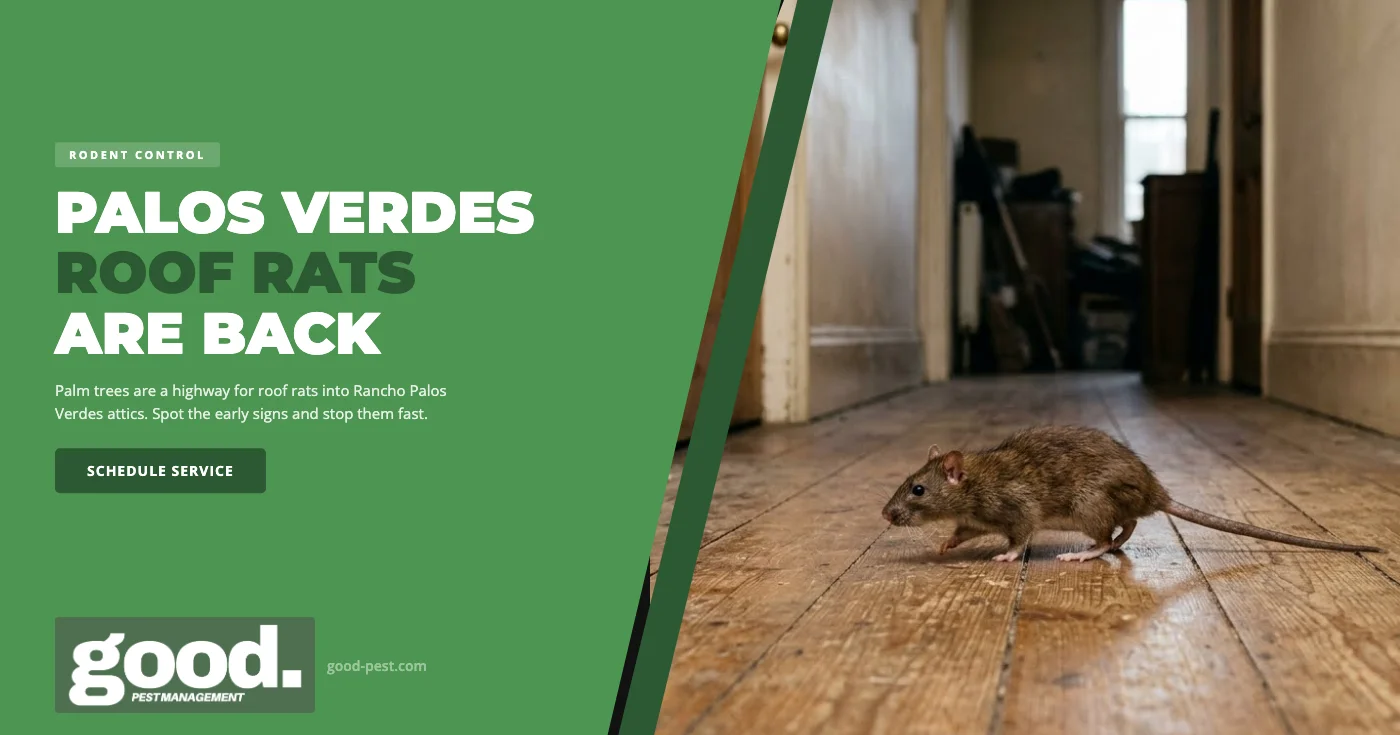
Roof Rats are sleek and slender, typically 6–8 inches in body length with a tail longer than their body. Their fur is smooth, usually dark brown or black on top with a lighter underside. They have large, prominent ears and a pointed muzzle, and they're exceptional climbers — you'll most often find signs of them in elevated areas like attics, rafters, the upper portions of walls, and along roof edges.
Norway Rats are heavier and stockier, with a blunt nose, smaller ears, and a tail shorter than their body length. They tend to burrow in the ground and establish nests at lower levels — basements, crawl spaces, and beneath appliances or concrete slabs.
House Mice are substantially smaller than either rat species, with large rounded ears relative to their body size. They can squeeze through openings as small as a dime and commonly nest inside walls, cabinets, and behind appliances.
In our experience serving Rancho Palos Verdes, roof rats are by far the most common rodent we find inside residential structures — particularly in hillside neighborhoods where vegetation is thick and rooflines are complex. Their agility makes attic access straightforward, and they often establish nesting sites well before homeowners notice anything unusual.
Because roof rats are primarily nocturnal, most Rancho Palos Verdes homeowners never see the animals themselves. What you're more likely to encounter are the physical signs they leave behind. Our team trains clients to look for the following indicators:
If you're noticing any of these signs in or around your Rancho Palos Verdes home, prompt action is important. Roof rat populations grow quickly, and a small initial infestation can expand significantly in just a few weeks. Our Rodent Control services begin with a thorough inspection to locate active entry points, nesting areas, and foraging routes so we can build a targeted treatment plan specific to your property.
Roof rats are far more than an annoyance — they present real risks to both your property and your household's well-being. These risks help explain why Rancho Palos Verdes homeowners should take even early signs of activity seriously.
Structural and electrical damage: Roof rats gnaw on wood framing, drywall, plastic plumbing, and electrical wiring. Chewed wiring inside walls and attics is a particular concern because it creates a fire risk in locations that aren't visible until significant damage has already occurred.
Contamination: Roof rats leave droppings, urine, and saliva as they travel through your home. These contaminants can reach food storage areas, kitchen surfaces, and HVAC ductwork, creating serious hygiene concerns throughout your household.
Disease risks: According to the CDC, rats can transmit diseases either directly through contact with their waste or indirectly through the fleas, ticks, and mites they carry. In California, this includes concerns about leptospirosis, salmonellosis, and rat-bite fever — all documented health risks associated with rodent infestations.
Insulation damage: Roof rats frequently nest in attic insulation, compressing and soiling it until it can no longer function effectively. Damaged insulation reduces energy efficiency and may require full replacement, adding unexpected costs to the remediation process.
Disruption to peace of mind: Living with an active infestation is genuinely stressful. Sounds, odors, and the awareness that rodents are moving through your home can be distressing for the entire household.
In Rancho Palos Verdes, where proximity to open hillside areas and dense landscaping creates ongoing outdoor rodent pressure, a roof rat problem rarely resolves on its own. Without professional intervention, populations grow and damage compounds.
One of the first questions Rancho Palos Verdes homeowners ask us is: how are they getting inside? The answer almost always comes down to the same combination of factors — and many of them are specific to the architectural styles and landscaping character common on the Palos Verdes Peninsula.
Tree branches and overhead vegetation: Roof rats are exceptional climbers. Any branch that extends within three to four feet of your roofline provides a direct pathway onto the roof. Utility lines running from the street to the exterior of your home serve the same function and are routinely used by roof rats as travel corridors.
Roofline gaps and degraded vents: Aging fascia boards, damaged soffit panels, and improperly screened attic and gable vents are among the most common entry points we identify during Rancho Palos Verdes inspections. An adult roof rat can squeeze through an opening slightly smaller than half an inch.
Gaps around pipes and conduit: Plumbing and electrical conduit that penetrates exterior walls often leaves small unsealed gaps. These openings become entry points that rodents use repeatedly once discovered.
Garage access: Worn weatherstripping, unscreened vents, and gaps along the door frame or at transitions to the main structure all give roof rats an easy pathway into the home.
Foundation and crawlspace vents: While roof rats prefer elevated entry, damaged crawlspace screens and deteriorated foundation vents provide viable ground-level access when other pathways are blocked.
Our inspections in Rancho Palos Verdes focus on identifying all viable entry points and developing a comprehensive exclusion plan. Without sealing those entry points, new animals from the outdoor population will simply find the same pathways again.
Prevention is consistently more effective — and more affordable — than responding to an established infestation. Here are the strategies our team recommends most consistently to homeowners throughout Rancho Palos Verdes:
Trim trees and vegetation back from the roofline: Maintain at least three to four feet of clearance between tree branches and your roof surface, and at least two feet between dense shrubs and exterior walls. Reduce or remove ivy ground cover along fences and the base of your home where roof rats nest and travel during daylight.
Harvest and manage fruit promptly: Don't allow fallen fruit to accumulate under trees. Harvest what you can, and consider protective netting for trees that repeatedly attract foraging rats. Keep compost bins fully sealed with locking lids.
Eliminate food and water sources: Bring pet food and water bowls inside at night. Store birdseed in sealed metal containers rather than bags. Address dripping irrigation lines and outdoor faucets that create puddles or standing water near the structure.
Proactively seal entry points: Even without current evidence of roof rats, a professional exclusion inspection can identify and seal potential entry points before they're discovered. Galvanized hardware cloth (¼-inch mesh) is the most effective material for screening vents and larger gaps; copper mesh and caulk address smaller openings.
Secure your garage: Replace worn weatherstripping so garage doors seal fully at the floor. Screen garage vents and inspect for gaps along the door frame.
Store materials off the floor: Cardboard boxes and loose household items create ideal nesting opportunities. Store items in sealed plastic bins elevated off the floor where possible.
Schedule annual professional inspections: In Rancho Palos Verdes, where climate and landscape create year-round conditions favorable to roof rats, we recommend annual inspections even for homes without current evidence of activity. Early detection saves considerable time and cost.
Q: I heard scratching in my attic once — does that definitely mean I have roof rats?
A: Not necessarily, but it's worth investigating. A single scratching event could be a roof rat exploring your attic for the first time, or it could be another animal — a squirrel, bird, or opossum. We recommend a professional inspection if you hear sounds more than once or if you find any physical evidence such as droppings, gnaw marks, or disturbed insulation. In Rancho Palos Verdes, early detection makes a significant difference in how quickly and effectively we can resolve the problem.
Q: Can I manage a roof rat problem with store-bought traps and bait?
A: DIY trapping can catch individual rats, but it rarely addresses the full scope of an active infestation or closes the entry points that allowed rats in. Roof rat populations in Rancho Palos Verdes can include many individuals spread across your attic and wall voids, with entry points that aren't obvious without a trained inspection. Professional service ensures that the full population is addressed, all viable entry points are sealed, and nesting areas are properly sanitized — significantly reducing the likelihood of recurrence.
Q: How long does professional roof rat treatment take to show results?
A: Most treatment programs produce a noticeable reduction in activity within one to two weeks. Exclusion work is typically completed in one or two visits, and follow-up monitoring confirms that activity has fully stopped. Our team will walk you through the expected timeline during your initial consultation for your Rancho Palos Verdes property.
The challenge of roof rats rancho palos verdes homeowners face each summer requires local knowledge, thorough inspections, and a treatment approach tailored to the specific landscape and architecture of the Palos Verdes Peninsula. At Good Pest Management, our team has helped residents throughout Rancho Palos Verdes protect their homes from roof rats and other rodent pressures with professional, effective service.
We understand that an active rodent infestation is stressful and disruptive. Our goal is to restore your peace of mind quickly — with a transparent inspection, a clear treatment plan, and follow-up support to confirm the problem stays resolved. We serve Rancho Palos Verdes and surrounding South Bay communities, bringing the same level of care to every property we treat.
Whether you're already hearing signs of roof rat activity in your Rancho Palos Verdes home or want a proactive inspection before problems develop, we're ready to help. Contact Us today to schedule a consultation and protect your home this summer.