
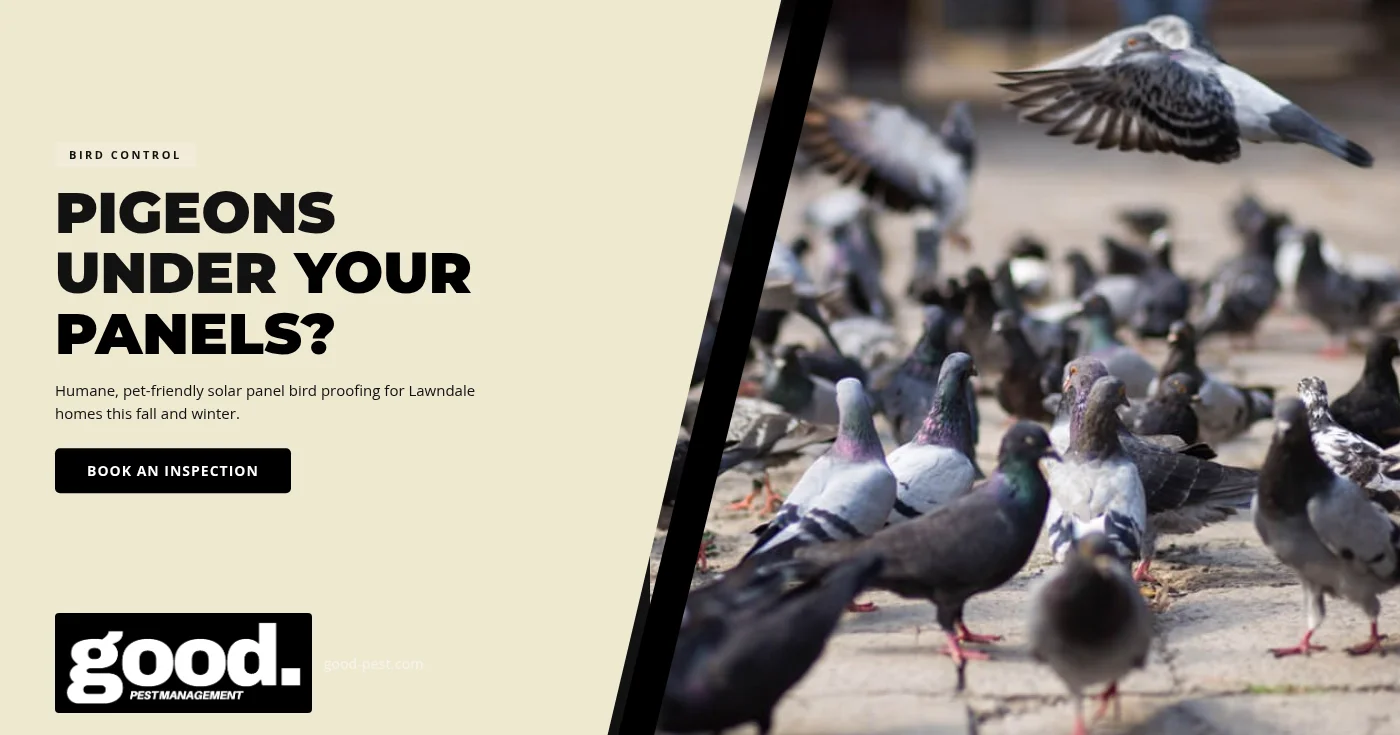
If you’ve heard cooing above your ceiling at dawn or spotted twigs poking out from under your solar array, you’re not imagining things. As fall nights cool off, pigeons go looking for sheltered spots, and the gap beneath rooftop panels is one of their favorites. If you’re searching for pigeon control in Lawndale, CA, you’re in good company. It’s one of the most common calls we get once the weather turns.
Here at Good Pest Management, we help South Bay homeowners and property managers deal with pigeons under solar panels using humane, pet-friendly exclusion instead of harsh quick fixes. Our bird control work focuses on sealing birds out for good, so your panels, roof and family get lasting protection.
Below, we cover why pigeons move in this time of year, the signs to watch for, what nests really cost you, why DIY deterrents fall short, how professional pigeon exclusion works and what to expect when you book with us.
November in the South Bay is usually mild, with lows around the low 50s and highs in the upper 60s to low 70s. That sounds pleasant to us, but for a pigeon, cooler nights and the first rains of the season are a signal to find shelter. The space under a rooftop solar panel checks every box: it’s shaded, protected from wind and rain, hidden from hawks and warmer than open roof.
According to UC IPM’s Pest Notes on pigeons, pigeons can breed year-round where winters are mild, and a pair may raise several broods a year, usually two eggs at a time. They also tend to return to the same nest site again and again. A pair that settles under your panels in fall may still be there, with company, by spring.
Lawndale’s mix of commercial strips, schools and parks gives pigeons easy meals all year. Add a neighborhood full of rooftop solar, and it’s easy to see why so many local homes end up with pigeons nesting on the roof once the weather turns.
Pigeons aren’t subtle once they settle in, but the early clues are easy to miss if you rarely look at your roof. Here’s what we tell homeowners to watch for, especially in winter, when birds spend more time tucked under panels:
One or two birds resting on your roof now and then isn’t a crisis. But if you notice several of these signs together, there’s a good chance an active nest is under your panels. The sooner you deal with it, the less cleanup and potential damage you’ll face later.
Droppings build up fast under a busy nest. Over time they can stain roofing and panel frames, and droppings on the glass can cut into how much power your panels produce. The effect varies too much to put a number on, but heavy soiling is rarely good for output. Nest material and feathers also wash into gutters and downspouts, where they can block drainage and hold moisture against the roof.
The wiring beneath an array isn’t built to live under a nest. Birds can tug at, soil or pack debris around cables and connectors, which may lead to costly service calls. Spilled seed and nest material can also draw rodents, so if we notice droppings or gnaw marks along the roofline, our rodent control team can take a look.
Dried pigeon droppings can carry fungi linked to illnesses such as histoplasmosis and cryptococcosis. The CDC notes that most healthy people who breathe in these spores don’t get sick, but the risk is higher for people with weakened immune systems. Nests can also harbor bird mites. If you must handle droppings, don’t dry-sweep them; dampening the debris and wearing a properly fitted respirator is the commonly recommended approach. Better yet, leave rooftop cleanup to a professional crew.
We understand the urge to handle it yourself. Unfortunately, most DIY fixes don’t hold up on a solar array.
There’s also the roof itself. Climbing a pitched roof and reaching under panels is risky, and it’s easy to scratch glass, loosen wiring or crack tiles. Lasting results come from physically closing the gap, done carefully by people who do this work regularly.
Pigeon exclusion is simple in concept: make the space under your panels impossible to enter, and the birds move on. Doing it well takes a careful process.
We start by inspecting the array, roofline, eaves and vents to see where birds are getting in and whether nests are active. We also confirm the species. Feral rock pigeons are non-native and aren’t protected under the federal Migratory Bird Treaty Act, and California generally treats them as non-game birds. Mourning doves look similar but are protected, so correct identification matters before anything is moved.
Next, we remove old nest material and droppings using protective gear and wet-cleaning methods to keep dust down. If we find eggs or young birds, we’ll talk through humane options and timing with you rather than rushing.
The core of solar panel bird proofing is a durable mesh barrier, typically galvanized or PVC-coated wire, fitted around the perimeter of the array. It attaches to the panel frame with clips, so there’s no drilling into your roof or panels. The mesh is low-profile, lets air circulate and rain drain, and blends in from the street. Because it’s a physical barrier rather than a spray or bait, it’s a pet-friendly, eco-friendly fix that doesn’t need ongoing treatments.
Late fall and winter are the ideal window for pigeon exclusion. Nesting in Southern California tends to ramp up in spring, so sealing your panels now means birds have nowhere to settle when that peak arrives. It also lowers the chance of finding nests with eggs or chicks, which makes the whole process more humane.
A few habits help your exclusion hold up:
Winter also brings more rats and mice looking for warm spots, so a recurring plan lets us watch for all of it at once.
Here at Good Pest Management, we built our business on fast, friendly communication, and that carries into every bird job. Here’s how it usually goes:
We’re licensed and insured, members of the National Pest Management Association, and our work is backed by a 100% satisfaction guarantee. Our team speaks English and Spanish. As a local business, we serve homes and properties throughout Torrance and the South Bay, so getting to you is never a long trip.
Our mesh clips to the panel frame without drilling into the roof or panels, so it doesn’t create new holes or leak points. Warranty terms vary by manufacturer, though, so we recommend checking your panel and installer documentation. We’re happy to review it with you first.
In most cases, yes. Feral pigeons aren’t covered by the Migratory Bird Treaty Act and are generally treated as non-game birds in California. Local requirements may apply, so it’s worth confirming with the California Department of Fish and Wildlife. Correct identification is key, because protected mourning doves look similar.
For most healthy people the risk is low, but dried droppings can carry fungi linked to respiratory illness, and the risk is higher for anyone with a weakened immune system. Keep kids and pets away from buildup and let a professional handle cleanup. If you have health concerns, talk with your doctor.
We handle this case by case. Often the most humane choice is to time the work around the nest, or partially seal the array and finish once the young have left. We’ll explain your options before anything happens.
Pigeons under solar panels won’t leave on their own, and every month they stay means more droppings, more debris and a bigger cleanup. The good news is that professional pigeon control in Lawndale, CA is quick, humane and built to last. Since opening in 2024, Good Pest Management has grown from knocking on doors to serving more than 2,000 customers across Lawndale, Torrance and the greater Los Angeles area, and we’d love to help you next.
Ready for a pigeon-free roof? Contact our team to schedule your inspection today. Good Pest, Bad News for Bugs—and for pigeons looking for a winter home.
Here at Good Pest Management, we make solar panel bird proofing simple. We start with a fast inspection, confirm the species and give you a clear plan before any work begins. Then we:
Our approach is humane, pet-friendly and eco-friendly—no harsh baits, just a physical barrier that keeps birds out. We’re licensed and insured, proud NPMA members, and our work is backed by a 100% satisfaction guarantee. One-time visits include a 2-week warranty, and recurring plans are fully warrantied in between scheduled visits. Whether you own a single-family home or manage several properties, we tailor the work to your roof and your schedule.
Pigeons are just one part of what we do. Explore our full list of pest control services, from ants and spiders to termites and rodents, or contact us to book your inspection. We offer same-day inspections when available, our team speaks English and Spanish, and we’re always quick to reply. Good Pest, Bad News for Bugs.