
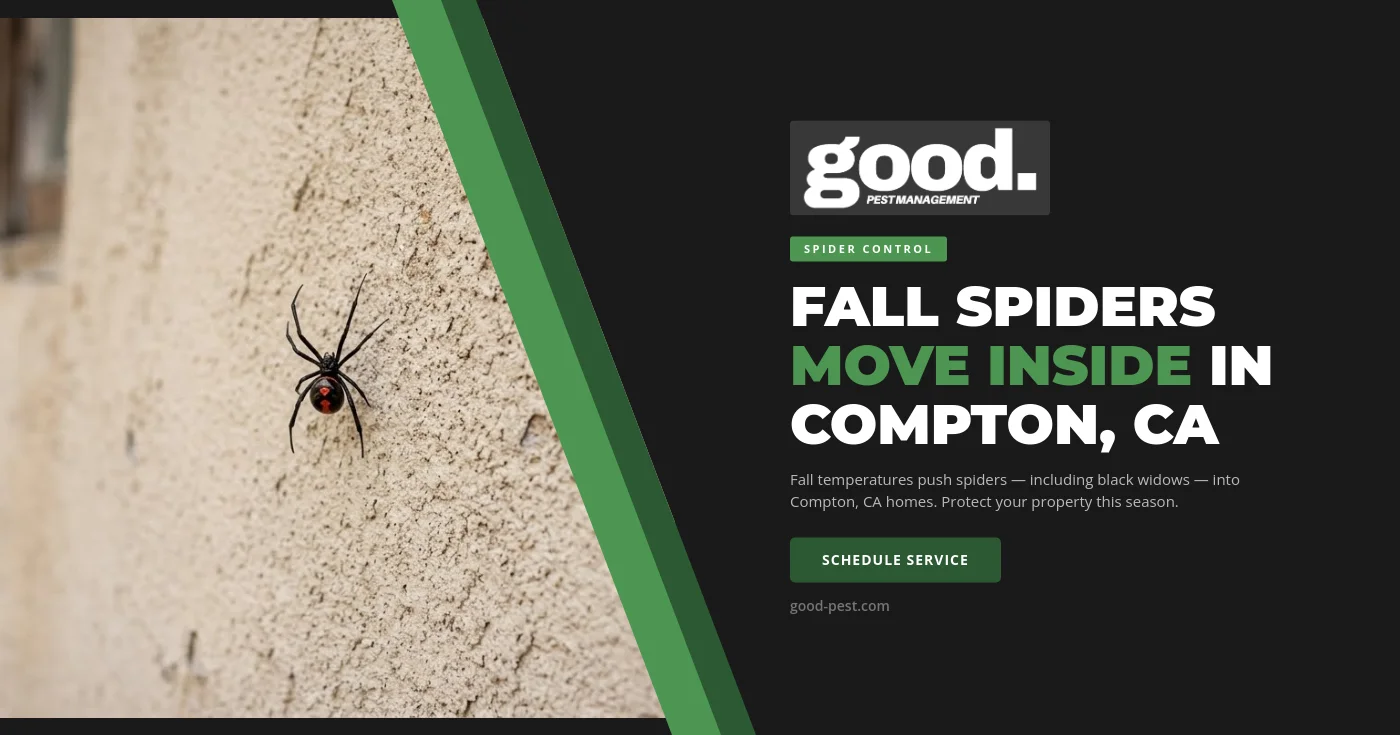
As fall settles in across Compton and the South Bay, our team at Good Pest Management starts fielding a familiar wave of calls. A homeowner opens a garage after sunset and spots three fresh webs between the ceiling and the shelving. A child picks up a pair of garden gloves off the back patio and feels something move inside. A tenant notices a dark, pea-sized spider with a red hourglass tucked into the recessed grip of the outdoor trash bin. Every October and November, our Compton call volume for spider work climbs sharply — almost all of it traces back to the same seasonal shift happening outside. This guide walks Compton homeowners through why fall drives spiders indoors, which species actually matter here, and what effective spider control in Compton, CA looks like when you want the problem resolved for the season.
Spider populations in Compton do not spike in fall because new spiders arrive. They spike because the ones already living outside become more visible, more mobile, and far more likely to end up on the wrong side of a door. Three seasonal pressures stack at the same time.
The first is temperature. Overnight lows slide into the low 60s and upper 50s by mid-October, pushing cold-blooded insects — the spider prey base — closer to warm structures. Spiders follow the food. Warm garage interiors, porch lights that attract flying insects, and heat-holding exterior walls become productive hunting ground.
The second is mating season. Fall is when mature male spiders of several common species leave their webs to wander looking for females. They are the ones most likely to be seen trotting across a hallway floor at night or running up a bathroom wall between September and early December.
The third is the Santa Ana wind pattern that hits the LA Basin from late September through October. Dry, warm offshore winds strip humidity out of outdoor harborage, and spiders that spent the summer in a damp palm skirt or the back of a wood pile start searching for cover with better moisture — usually a garage, a utility closet, or the sheltered corner behind an outdoor planter.
Most of the resident spiders in Compton do not die back over winter — they slow down. That makes fall the single most important window of the year for spider management, because the populations relocating indoors now are the ones that overwinter inside the structure.
Not every spider showing up in a Compton home is dangerous. According to the University of California Statewide Integrated Pest Management Program (UC IPM), only the widow spiders present any real medical concern in California — the rest of the common species are either harmless hunters or nuisance web-builders. Knowing which species we are actually dealing with changes the treatment plan entirely.
In our Compton and South Bay work, the species we identify most often in fall are:
If a Compton homeowner cannot identify a specific spider with confidence, the right move is to leave it alone until a technician can look at it. Photographing from a distance is more useful than trying to collect the specimen.
The two widow species are the reason spider calls in Compton get treated with urgency. Both carry neurotoxic venom, both are present year-round in the South Bay, and both are more likely to be noticed in fall as homeowners pull holiday decorations out of garages and clean up yards after summer.
Per UC IPM, black widow bites are rare — the spiders are reclusive, nocturnal, and avoid people whenever possible. Nearly all medically significant bites come from adult females and happen when a person reaches into a dark, undisturbed space without looking: a stored shoe, a gardening glove left in the shed, or the recessed grip on an outdoor trash bin. Symptoms can include severe muscle cramping, abdominal pain, and sweating, and children, older adults, and anyone with underlying heart conditions are at higher risk of a serious reaction. Any suspected black widow bite warrants a prompt call to 911 or a medical provider.
Brown widow venom is less potent, and the medical reaction is usually milder and more localized. When disturbed, brown widows typically drop out of their web and curl up motionless rather than striking. But they reproduce prolifically — a single egg sac can contain a hundred or more spiderlings — and their preference for plastic outdoor furniture, mailboxes, and wrought-iron railings means Compton homes with any of those features can quickly accumulate a dense local population.
Both widow species concentrate in the same places: garage corners near the floor, undersides of plastic patio furniture, hollow spaces in concrete block fences, electrical and irrigation boxes on exterior walls, recessed grips of outdoor bins, inside empty plant pots, and sheltered corners of covered porches. A walk around the exterior with a flashlight after dark — looking at those spots — is one of the fastest ways to find out whether widows are present.
Once spiders cross the threshold into a Compton home in fall, they concentrate in a short list of predictable interior spots that share three traits: low human traffic, stable temperatures, and consistent insect activity nearby.
The interior spots we check first on every Compton inspection are:
Between an initial sighting and a professional treatment, there is meaningful work a Compton homeowner can do. None of these steps will eliminate an active widow population on their own, but they slow new incursions and make professional treatment more durable.
Outdoor steps that produce the biggest results:
Structural steps at the home itself:
What consistently does not work: ultrasonic repellers, peppermint sprays, essential-oil fogging kits, and perimeter-only treatments applied without an inspection. Spiders are not insects, and most residential insect products have limited effect on them. A real spider program targets harborage and prey base at the same time.
Some spider sightings in a Compton home are a routine fall event — a single wandering male across the hallway at night, a cobweb in the back of an unused closet. Others point to an established population that is not going to resolve on its own. The signs that warrant a professional inspection are:
Our team at Good Pest Management treats spider problems across Compton, the LA Harbor area, and the broader South Bay as an integrated job: full exterior and interior inspection to identify species and locate harborage, targeted treatment of nests and egg sacs rather than blanket perimeter spraying, removal of webs and sacs during the visit, and recommendations for the specific exclusion and landscape changes that will keep the problem from returning. Our products are pet-friendly and eco-friendly, our technicians are licensed and insured, and the work is backed by our 100% satisfaction guarantee. As an NPMA-member local company, we know the construction patterns, landscaping types, and widow habitat specific to Compton homes.
Are there dangerous spiders in Compton, CA?
Yes. Both the western black widow and the brown widow are present year-round in Compton and across the South Bay. Both carry neurotoxic venom. Bites are rare because widows are reclusive, but any confirmed widow on a property with children, elderly residents, or pets warrants prompt professional attention.
Why am I seeing so many spiders inside my Compton home this fall?
Fall is peak season for spider activity in Southern California. Cooler nights push the insect prey base closer to warm structures, mature male spiders leave their webs to seek mates, and the Santa Ana wind pattern drives outdoor populations toward sheltered indoor environments. The spiders have been on the property all along — fall is when they become visible.
Can I handle a spider problem myself with store-bought sprays?
For a one-off nuisance spider, yes. For an established population — especially widows — no. Over-the-counter products rarely reach widow retreat spots, do not remove egg sacs, and do not address the outdoor harborage producing the spiders. Spider work needs to be inspection-driven, not spray-driven.
What should I do if I think someone was bitten by a black widow?
Seek medical attention immediately — call 911 or a medical provider. Photographing the spider from a distance helps with identification, but do not try to capture it.
How long does professional spider treatment usually take?
A typical Compton spider job runs one to three visits over four to six weeks, depending on the species, the extent of harborage, and the structural factors involved. We follow up until we are seeing zero active webs and no new egg sacs.
When is the best time of year to schedule spider control in Compton?
Late August through early October is the ideal window. Getting the inspection, exclusion, and initial treatment done before the fall population shift means the resident indoor population never establishes in the first place. If spiders are already showing up inside, the next-best time is now.
If you have confirmed a black widow or brown widow anywhere on your Compton property, are finding fresh webs across your garage ceiling, or spotting tan, marble-sized egg sacs under outdoor furniture, the resident population is already producing the next generation and will not resolve on its own. Over-the-counter sprays rarely reach widow retreat spots and do nothing about the outdoor harborage pulling them in. Our team at Good Pest Management inspects the full property, identifies species on sight, treats nests and egg sacs directly, and sweeps webs during the visit — all with pet-friendly, eco-friendly products backed by our 100% satisfaction guarantee. Contact us today to schedule your Compton spider control inspection.