
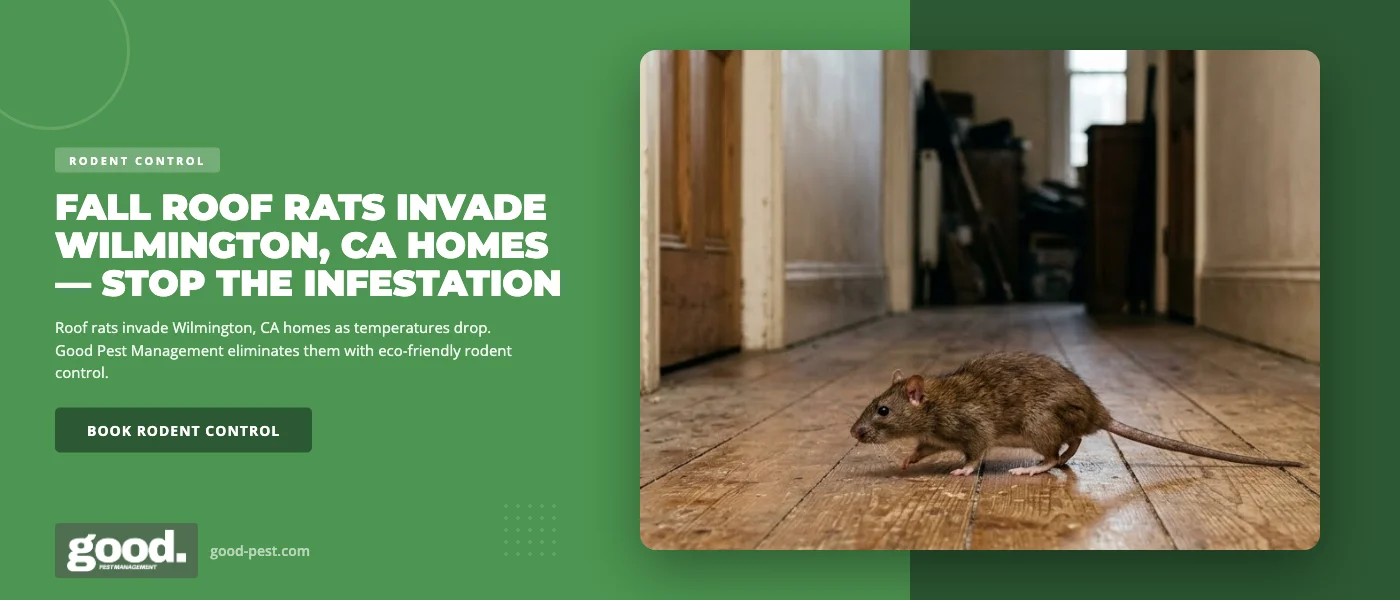
As the first cool nights of fall settle over Wilmington and the Los Angeles Harbor, our team at Good Pest Management starts fielding a familiar wave of calls. Homeowners hear soft scratching in the attic after dark, spot half-eaten citrus on the ground beneath their trees, or find dark, spindle-shaped droppings tucked behind the garage. Almost every time, the culprit is the same: roof rats, moving out of the ivy, fruit trees, and dense outdoor cover they occupied all summer and pushing their way into homes for the season ahead. This guide walks Wilmington homeowners through why fall is the tipping point every year, how these rats find their way inside, and what effective roof rat control in Wilmington, CA actually requires.
Roof rats (Rattus rattus) do not disappear over the summer. They spend the warm months living outdoors — in palm skirts, tangles of English ivy, ornamental fruit trees, and the dense ground cover common in older Wilmington neighborhoods and along the harbor. They eat fallen citrus, avocados, seeds, and pet food left on porches, and they nest in the leaf canopy above your roofline. What changes in fall is not the population. What changes is the pressure.
The University of California Statewide Integrated Pest Management Program (UC IPM) notes that roof rat populations in California climates peak in spring and fall, and adult females can produce three to five litters a year with up to eight offspring each. By the time September arrives, the summer generations are fully grown, competing for the same outdoor food and harborage. As nights cool, ornamental fruit trees drop their last hangers, and irrigation timers scale back for the fall, the outdoor buffet shrinks fast. Rats that were content in a lemon tree canopy in July start scouting for a warmer, more reliable place to nest by mid-September — and the closest option is usually the attic of the nearest home.
Wilmington sits in a particularly favorable pocket for this seasonal shift. The neighborhood mixes older residential blocks with dense mature landscaping, industrial edges along the harbor, and a network of alleys, garages, and detached buildings that give rodents constant vertical access. Add coastal fog, mild overnight temperatures that never trigger a natural population crash, and year-round ornamental fruit, and roof rats have every reason to move indoors as soon as the outdoor conditions cool. September through November is the window when the shift is most aggressive, and it lines up almost exactly with when our team's Wilmington call volume spikes.
Roof rats earned their name for a reason. Unlike Norway rats, which burrow at ground level, roof rats are elite climbers that prefer to enter homes from above. They travel along utility lines, fence tops, palm trunks, and overhanging branches, and they can jump several feet from a branch to a roof edge. Once on the roof, they exploit any opening larger than a half-inch — roughly the diameter of a dime — to get inside.
In Wilmington homes, the most common entry points our technicians find, in order, are:
Rats do not need to squeeze — they only need one opening in an entire structure. A single half-inch gap somewhere along a roofline can seat a colony in an attic within days, and the same route gets used generation after generation until it is sealed with materials rats cannot chew through.
Because roof rats stay high in the structure and are almost entirely nocturnal, most Wilmington homeowners spot secondary signs long before they spot a rat. Our team encourages residents to watch for these indicators, especially through the September–November window when populations are actively relocating indoors:
The earlier those signs are noticed, the smaller the population still to eliminate and the less structural and electrical damage the rats will have caused in the meantime.
Roof rats are not just a nuisance. A population inside a Wilmington home creates real risks on two fronts — public health and structural integrity — and both grow the longer the problem is left unaddressed.
On the health side, UC IPM documents that rats can transmit murine typhus, leptospirosis, salmonellosis, and rat-bite fever, along with several food-borne illnesses spread through contamination of pantry items and food-preparation surfaces. Roof rats do not typically carry rabies, but their droppings, urine, and shed hair can trigger allergy and asthma symptoms in sensitive household members, and their nests attract secondary pests such as fleas and mites that then move into the living space. In coastal Los Angeles neighborhoods, murine typhus in particular has been documented for years as an active, if uncommon, exposure risk tied to rat and flea activity.
The structural risks are just as important to understand, because they compound quickly. Roof rats gnaw electrical wiring to keep their incisors trimmed, and chewed wiring inside a Wilmington attic is a genuine fire risk — insurance industry data has linked a meaningful share of unexplained residential electrical fires to rodent damage. Rats also chew through irrigation lines and low-voltage landscape wiring, tear apart attic insulation to build nests (which drops the R-value of the affected area and shows up on the next power bill), and contaminate stored items with urine and droppings that then require full disposal rather than cleaning.
A single fall's worth of unchecked roof rat activity in an attic can produce thousands of droppings, several damaged runs of wiring, and enough nest material to require full attic decontamination and re-insulation before the space is usable again. Catching the problem in September is a very different repair than catching it in February.
Between an early sighting and a professional inspection, there are a handful of steps Wilmington homeowners can take right now to reduce pressure on the structure. These will not eliminate an established colony, but they meaningfully slow new incursions and make professional treatment more durable.
Outdoor changes that matter most:
Structural changes at the roofline:
What consistently does not work: ultrasonic repellers, mothballs, peppermint spray, and single-feed store-bought snap traps for an established roof rat population. Ultrasonic devices have no meaningful effect on rat behavior, mothballs do not repel rodents at legal use rates, and hardware-store snap traps placed on the floor almost never reach roof rats living in the attic. These approaches burn time that a fall infestation does not give you.
If scratching in the ceiling, fresh droppings in the garage rafters, or hollowed-out citrus on the trees are already showing up around your Wilmington home, an active roof rat population has almost certainly established itself and is growing. Fall generations reproduce quickly, and a colony that takes hold in September can occupy an attic through the entire cool season if it is not fully removed. Store-bought traps, off-the-shelf bait blocks, and one-off exclusion patches rarely resolve the problem, because they treat the symptoms without addressing the entry points, the outdoor pressure, or the reproductive cycle happening inside the walls.
Our team at Good Pest Management treats roof rat infestations across Wilmington, the LA Harbor area, and the wider South Bay as a complete rodent management job: full interior and exterior inspection to map the entry points and runways, targeted trapping and bait station placement in the attic and along active runs, exclusion work with hardware cloth and metal flashing to seal every opening we find, and follow-up visits until activity stops. We use eco-friendly, pet-friendly products and back the work with our 100% satisfaction guarantee. As a licensed and insured, NPMA-member local company, we know the roof lines, tree species, and construction quirks specific to Wilmington homes, and we build the treatment plan around what is actually happening on your property — not a generic protocol.
How do I tell roof rats apart from Norway rats?
Roof rats are sleeker and smaller than Norway rats, with a pointed muzzle and a tail that is longer than the head and body combined. They climb; Norway rats burrow. If the activity is in your attic, ceiling, or garage rafters, it is almost certainly roof rats.
Why do I have roof rats if my home is clean?
Roof rat pressure in Wilmington comes almost entirely from the outdoor environment — fruit trees, ivy, palm skirts, and neighboring landscaping — not from indoor cleanliness. A spotless home with a lemon tree and unscreened vents is still an attractive target in the fall.
Are roof rats dangerous to my family or pets?
Yes, they carry disease risks and their droppings and urine contaminate surfaces and food. They also chew wiring, which is a fire risk. Pets that catch or eat a rat can pick up fleas and mites that were living on the rat.
How long does professional roof rat removal take?
Most Wilmington roof rat jobs run three to six weeks from first inspection to activity fully stopping. The timeline depends on the size of the colony, the number of entry points to seal, and the outdoor conditions on the property. We stay on the job with follow-up visits until we are seeing zero fresh activity.
Will trimming my trees really make that much difference?
Yes. Trimming branches four to six feet back from the roofline eliminates the primary access route for roof rats in most Wilmington homes. Combined with sealing the top-tier entry points, tree work is one of the highest-leverage things a homeowner can do before the fall season peaks.
What time of year should I schedule an inspection?
Late August through early October is the ideal window in Wilmington. Getting the inspection and exclusion work done before the seasonal push means the population never establishes indoors in the first place. If you are already hearing activity, don't wait — the sooner treatment starts, the smaller the job.