
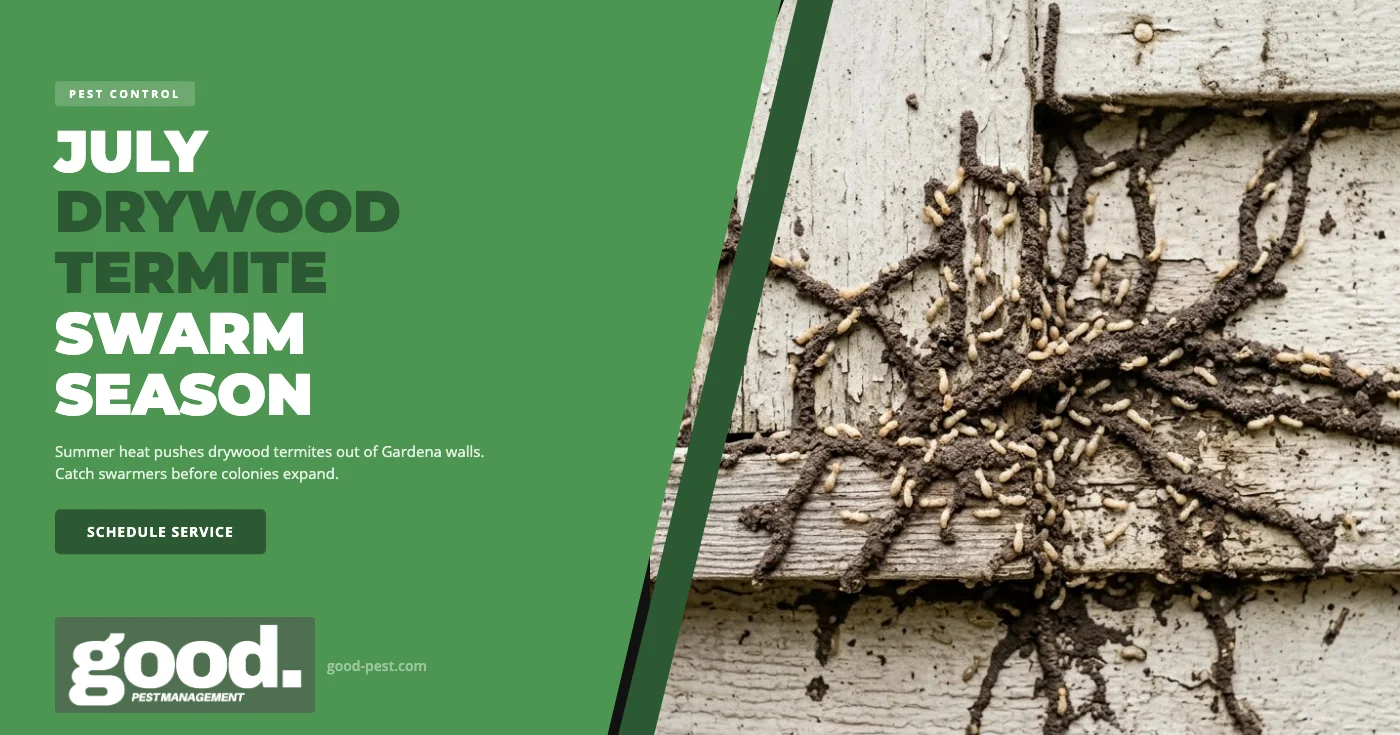
If you spotted a cluster of small, reddish-brown insects around a window in your Gardena home this week, you may be watching the opening act of drywood termite swarm season. Effective drywood termite control in Gardena, CA starts with understanding why July matters so much — and what those tiny winged insects really are. Across the South Bay, warm afternoons, long daylight hours, and the specific life cycle of Incisitermes minor (the western drywood termite) converge in mid-summer to trigger the year's largest reproductive flights. At Good Pest Management, we field more drywood termite calls in July and August than any other months, and most of those calls begin with the same sentence: "I saw something strange on the window sill."
That single observation often turns out to be one of the most important early warnings a South Bay homeowner can catch. Below, we walk through what's actually happening inside your walls this month, how to tell termites from flying ants, the subtle signs of an established colony, and the treatment paths our team uses to protect Gardena properties.
The western drywood termite is one of the most damaging wood-destroying insects in California, second only to subterranean termites in the amount of harm it causes each year. Unlike subterraneans, drywoods do not need contact with soil or a water source. They live entirely inside dry, sound wood — the framing, fascia, eaves, window casings, and attic timbers that make up a typical Gardena home.
Colonies release winged reproductives, called alates or swarmers, once a year to establish new colonies. In Southern California, that flight window opens in July and continues through September, with the busiest weeks usually falling between late July and mid-August. Warm, humid afternoons after a marine layer burn-off often trigger a flight, and swarmers are strongly attracted to light — which is why homeowners typically notice them at windows, skylights, or porch fixtures late in the day.
Because Gardena sits in a mature, densely built neighborhood grid with plenty of older wood-framed housing, the local drywood population has been established for decades. Every July, our technicians confirm new activity in homes that showed no signs the previous summer. Swarm season is not a fluke — it is the calendar you should mark on your wall.
The single most common mistake we see South Bay homeowners make in July is dismissing a small pile of winged insects as flying ants. The two look similar at a glance, but the differences are consistent once you know what to check.
Body shape. A drywood termite has a straight, cigar-shaped body with no pinched waist. A flying ant has a clearly narrow, hourglass-shaped waist between the thorax and abdomen. This is the fastest field ID you can make with the naked eye.
Antennae. Termite antennae are straight or very slightly curved, like a short string of tiny beads. Ant antennae are elbowed — they take an obvious 90-degree bend partway down.
Wings. Both insects have four wings, but the proportions differ. A drywood termite's wings are all roughly the same size and about twice as long as the body. Flying ants have larger front wings and noticeably smaller back wings.
Color. Western drywood termite swarmers are solid reddish-brown, sometimes described as the color of dark rust. Their wings are translucent and slightly milky, with three prominent veins that create trapezoidal cell patterns.
Shed wings. After a swarm, drywood termites shed their wings almost immediately. If you see a small drift of clear, fish-scale-shaped wings on a window sill, floor, or bathroom counter, that is a classic termite fingerprint. Flying ants tend to keep their wings intact for far longer.
When our team gets a call from a Gardena resident in July, the first thing we ask is whether the caller can photograph one of the insects or the shed wings. Nine times out of ten, that photo confirms the ID before we even walk through the door.
Swarmers themselves are only visible for a few weeks each year. The colonies they come from, though, can live inside a Gardena home for a decade or more before homeowners notice. Between swarms, the warning signs are subtle and easy to miss if you don't know what to look for.
Frass. This is the single most reliable indicator of an active drywood colony. Frass is the granular, six-sided pellet that termites push out of their galleries through tiny kick-out holes. It looks like a small pile of wood-colored salt or coffee grounds — usually tan, brown, or coffee-colored — and it collects on window sills, along baseboards, on the top of door casings, or on the floor directly beneath an infestation. If you have been sweeping up the same small pile of grit every few weeks and cannot figure out where it is coming from, look up.
Kick-out holes. These are the exit points termites use to expel frass and, during swarm season, to release reproductives. They are round, about the diameter of a pinhead, and are often plugged with a small brown cap when the colony is inactive.
Discarded wings. Alongside the front-door pile of swarmers, you may find tiny piles of shed wings behind curtains, on window ledges, or in the corners of rooms where the flight ended.
Clicking or rustling sounds. In quiet moments, a heavily infested wall or ceiling joist can produce a faint clicking noise as soldiers bang their heads against gallery walls to warn the colony.
Hollow-sounding wood. Tapping a baseboard, door frame, or window casing and hearing a dull, papery echo instead of a solid thud often means the wood has been hollowed out from the inside.
Because drywood termites do not need soil or moisture, their hiding places are different from what most homeowners expect. In Gardena's typical single-story ranch and mid-century wood-framed housing stock, we consistently find colonies in the same handful of locations.
Attics and roof framing. Rafters, ridge boards, and the underside of roof sheathing are prime real estate. Attics are warm, dry, and rarely inspected — an ideal environment for a small colony to expand quietly for years.
Window and door casings. The framing around sunlit windows is a favorite entry point for swarmers looking to start a new colony. Casings on south- and west-facing walls in Gardena homes tend to see the earliest activity.
Fascia, eaves, and trim. Exterior wood exposed to sun and weather, particularly older fascia boards along the roofline, is often the first place we find kick-out holes during an inspection.
Garages and detached structures. Detached garages, wooden fences, patio covers, and pergolas are frequently overlooked. Because these structures often escape routine inspections, they can serve as a reservoir of activity that later spreads to the main house.
Interior door frames and baseboards. Once a colony matures, secondary colonies can appear in interior framing far from the original entry point. This is why we always inspect the full structure, not just the obvious signs.
Drywood termites work slowly compared to subterranean species — but they do not rest. A mature colony of Incisitermes minor can hollow out a wall stud or roof rafter over the course of five to seven years, and larger homes often host multiple colonies simultaneously.
The damage is characteristically hidden. Termites eat with the grain of the wood, leaving a paper-thin outer shell that looks completely normal from the surface. Homeowners often discover the damage only when a section of a door frame gives way under light pressure, when an eave sags after a windstorm, or during a real estate inspection before sale.
In Gardena, where a large share of the housing stock predates 1970, that hidden damage can quietly reduce load-bearing capacity in critical framing members. Repairs can involve replacing structural lumber, refinishing interior trim, and sometimes rebuilding sections of roof or floor framing. The longer a colony works undetected, the more expensive that repair scope becomes.
The good news is that drywood termite damage is almost always addressable when caught early. That is why we treat every July swarm sighting in the South Bay as a call worth responding to promptly.
Once an inspection confirms active drywood termites, homeowners have two primary treatment paths: whole-structure fumigation or localized spot treatment. Both are recognized by UC IPM as effective when applied to the right situation, and choosing between them depends on how widespread the infestation is.
Whole-structure fumigation. This is the option most Gardena homeowners recognize by sight — the striped tent covering a house for two to three days. The process uses sulfuryl fluoride gas, which penetrates every piece of wood in the structure and eliminates every colony simultaneously, including infestations hidden inside walls, attics, and framing that inspection alone might miss. Occupants, pets, and houseplants must vacate the property for the duration. Fumigation has the highest overall success rate for structures with multiple or unknown colony locations, and it is our recommended approach for heavily infested homes or older properties where hidden activity is likely.
Localized spot treatment. For homes with a small number of clearly identified colonies — often a single window casing or a discrete section of trim — targeted treatment can be an effective, lower-disruption option. Licensed applicators inject a termiticide directly into galleries through existing kick-out holes or through small drilled ports. Occupants do not need to vacate, and treatment can usually be completed in a single afternoon. The limitation is that spot treatment only addresses colonies we can locate and confirm; any hidden colonies elsewhere in the structure remain untreated.
Our team walks through both options during every drywood inspection and helps you weigh cost, scope, and disruption against the extent of the infestation. There is no single right answer for every Gardena property — the right answer is the one that eliminates every colony in your specific home.
Every drywood termite job at Good Pest Management starts the same way: a thorough, top-to-bottom inspection of the property. Our licensed technicians examine attic framing, all window and door casings, exterior trim, fascia and eaves, garage and outbuilding wood, and every accessible section of interior baseboard and molding. We document every kick-out hole, frass pile, and shed wing we find so you have a clear picture of the scope before any treatment is recommended.
From there, we build a treatment plan that fits your home. Whether that means coordinating a whole-structure fumigation, executing a targeted spot treatment, or combining approaches on a larger property, our goal is the same — eliminate the active colonies and give you a clear path to preventing re-infestation.
Because drywood swarm season peaks right now, every week of July matters. If you have seen swarmers, frass, or shed wings anywhere on your Gardena property, our team is ready to inspect. Learn more about our full Termite Control program, or explore our broader Residential Pest Control services to see how we protect South Bay homes year-round. When you are ready to schedule an inspection, reach out through our website and a Good Pest Management team member will walk you through the next step.