
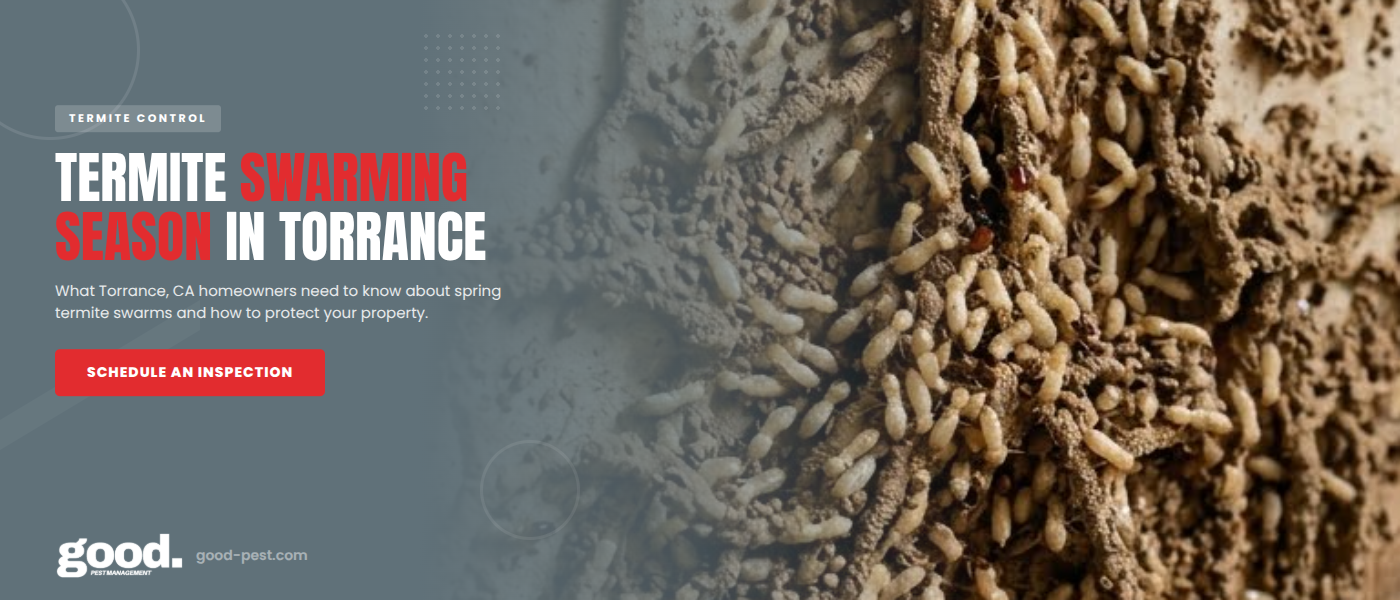
If you live in Torrance, CA, spring brings more than just warmer temperatures and longer days. It also signals the start of termite swarming season — the time of year when reproductive termites take flight to establish new colonies, often right inside your walls, attic, or foundation. At Good Pest Management, we respond to a sharp increase in termite calls from Torrance homeowners every spring, and we want you to understand exactly what swarming means, why it happens, and what you should do if you see winged termites on or near your property.
Termites cause billions of dollars in structural damage across the United States each year, and Southern California is one of the most termite-active regions in the country. The mild climate here in the South Bay allows multiple termite species to thrive year-round, but spring is when their activity becomes most visible. In this guide, we cover the swarming behavior of the termite species most common in Torrance, the warning signs of an active infestation, and the professional treatment options we use to protect your home.
Termite swarming is the reproductive process by which mature termite colonies produce winged adults — called alates or swarmers — that leave the nest in large numbers to mate and start new colonies. A single swarm event can release hundreds or even thousands of winged termites within a short window of time. For Torrance homeowners, seeing a swarm is often the first visible indication that a mature termite colony has been living in or near your home, potentially for years.
Swarming is triggered by a combination of environmental factors. In Torrance, the key triggers include:
Understanding this timeline is critical. A swarm does not represent the beginning of a termite problem — it represents a colony that has been established long enough to reproduce. Early detection through professional inspections is the most effective way to catch termite activity before a colony reaches swarming maturity.
Two primary termite species affect homes in Torrance and the greater South Bay, and each follows a distinct swarming pattern.
Western subterranean termites (Reticulitermes hesperus) are the most common species in the Los Angeles metro area. According to the UC Integrated Pest Management Program, subterranean termites live in underground colonies and build distinctive mud tubes to travel between the soil and the wood structures they feed on. In Torrance, they typically swarm from March through May on warm days following rainfall. The swarmers are dark brown to black with translucent wings roughly twice their body length. Subterranean termites are responsible for more structural damage in California than any other species, entering homes through foundation cracks, expansion joints, and any point where wood contacts soil.
Drywood termites (Incisitermes minor) are the second major threat in Torrance. Unlike subterranean termites, drywood termites do not require contact with soil or external moisture — they live entirely within the wood they consume. According to the UC IPM drywood termite guide, drywood termites are most prevalent in coastal Southern California. They typically swarm from late August through November, though smaller flights can occur during warm weather. One hallmark sign is frass — tiny, hexagonal fecal pellets that accumulate on windowsills and along baseboards beneath infestation sites.
Beyond the swarmers themselves, several warning signs can alert you to a termite problem before the damage becomes severe. We encourage Torrance homeowners to watch for these indicators throughout the year, but especially during spring swarming season:
If you observe any of these signs in your Torrance home, we strongly recommend contacting our team for a thorough inspection. Termite damage progresses steadily, and the cost of repair increases significantly the longer an infestation goes untreated. Most homeowner's insurance policies in California do not cover termite damage, which makes early detection and professional treatment all the more important.
At Good Pest Management, we provide comprehensive termite control services for Torrance homeowners that address both active infestations and long-term prevention. Our approach is built around thorough inspection, targeted treatment, and ongoing monitoring to ensure your home stays protected.
Detailed property inspection. Our licensed technicians inspect your entire property — interior and exterior — looking for evidence of active termite colonies, damage, entry points, and conditions that promote termite activity. In Torrance, we pay close attention to areas where wood contacts soil, foundation perimeters, crawl spaces, attic framing, and moisture-prone zones around plumbing and irrigation systems.
Species identification. Accurate identification is essential for selecting the right treatment. Subterranean and drywood termites require fundamentally different methods, and our team has extensive experience with both species across the South Bay.
Targeted treatment plans. For subterranean termites, we apply liquid termiticides to the soil around your foundation, creating a continuous treated zone that eliminates foraging termites and prevents new colonies from accessing your home. For drywood termites, localized treatments target specific infestation sites within the wood, eliminating the colony without full-structure fumigation in many cases.
Ongoing monitoring and prevention. Termite pressure in Torrance is continuous. Our recurring service plans include periodic inspections, monitoring station checks, and preventive treatments that maintain protection throughout the year. All of our treatments are eco-friendly and designed to minimize impact on your family, pets, and the surrounding environment.
While professional treatment is the most reliable way to eliminate and prevent termite infestations, there are several steps Torrance homeowners can take to reduce conditions that attract termites to your property:
In Torrance, subterranean termite swarming season typically runs from March through May, with peak activity occurring after warm spring rains. Drywood termites swarm later, primarily from late August through November. However, because of our mild coastal climate, smaller swarm events can occur at almost any time of year. We recommend maintaining year-round protection rather than treating termites as a seasonal concern.
Termite swarmers and flying ants look similar at first glance, but there are key differences. Termite swarmers have straight, beaded antennae, a thick waist with no constriction, and two pairs of wings that are equal in length. Flying ants have elbowed antennae, a narrow pinched waist, and front wings that are noticeably larger than the rear pair. If you are unsure, collect a sample and contact our team for identification.
Not necessarily, but it is a serious warning sign. If swarmers are emerging from inside your home — through cracks in walls, around window frames, or from baseboards — there is almost certainly an established colony feeding on your wood structure. If you see swarmers outside near your foundation, a colony is nearby and your home is at risk. In either scenario, we recommend scheduling a professional inspection promptly.
Termite damage repair costs vary widely depending on the extent and location of the damage. Minor repairs may cost several hundred dollars, while significant structural damage can run into the thousands. The longer an infestation goes undetected, the more extensive and expensive the repairs become. Because most California homeowner's insurance policies do not cover termite damage, prevention and early detection through regular inspections are the most cost-effective approach.
We do not recommend DIY termite treatment. Over-the-counter products lack the potency and application methods needed to eliminate entire colonies, especially subterranean colonies that extend deep into the soil. Incomplete treatment allows the colony to survive and continue causing damage. Professional treatment uses specialized equipment and products applied by licensed technicians who understand the biology and behavior of each species.
Termite swarming season in Torrance is a clear reminder that these destructive pests are actively seeking new homes to colonize — and your property could be their next target. At Good Pest Management, we have the expertise, the professional-grade treatments, and the commitment to ongoing protection that Torrance homeowners need to keep termites out for good. Whether you have seen swarmers, found mud tubes or frass, or simply want the peace of mind that comes with a professional inspection, we are here to help.
Ready to protect your home from termites? Contact Good Pest Management today to schedule your termite inspection and get a customized treatment plan for your Torrance, CA property.