
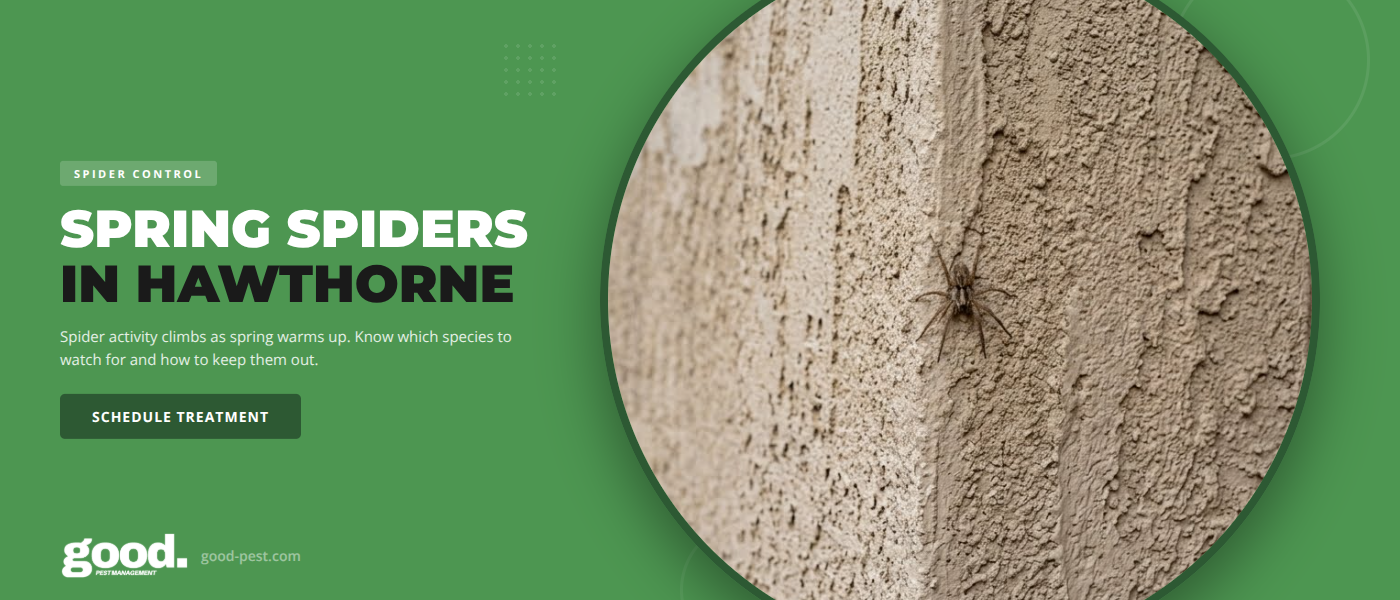
Spring in Hawthorne brings longer days, warmer afternoons, and gardens coming back to life across the South Bay — and it's also when spiders become noticeably more active around homes. If you're seeing more webs in garage corners, cellar spiders dangling near the bathroom ceiling, or the occasional dark spider scurrying along the baseboard, you're not alone. Spider control in Hawthorne, CA becomes a real concern this time of year for homeowners who want their spaces back without the daily web cleanup.
At Good Pest Management, we treat spider issues across Hawthorne and the broader South Bay year-round, and we know the seasonal patterns well. Most of the spiders we see are harmless — even beneficial — but a few species warrant attention, and a small amount of seasonal prevention goes a long way. This guide walks through which spiders are common around Hawthorne homes this spring, where they hide, what attracts them, and the practical steps that keep populations in check.
Spiders never fully disappear during a Southern California winter — they just slow down. Once daytime temperatures in Hawthorne climb consistently into the 60s and 70s, dormant spiders emerge from sheltered spots, egg sacs begin hatching, and populations expand quickly. By April and May, what looked like an empty garage corner in February is threaded with fresh webs.
Three factors drive that spring surge. Warmer weather wakes up the insects spiders feed on — gnats, flies, mosquitoes, ants, and moths — giving populations more food. Spring is also the primary mating and dispersal season; young spiderlings hatch in late spring and "balloon" on silk threads to find new territory, often landing in garages, sheds, and homes. And Hawthorne's marine layer keeps humidity higher than inland areas, extending the active range of moisture-loving species like cellar spiders and wolf spiders.
Most spiders we encounter in Hawthorne homes belong to a handful of recurring species. Knowing the difference helps you respond appropriately rather than reacting to every eight-legged guest the same way.
According to the UC Statewide Integrated Pest Management Program, the western black widow is the only spider in California whose venom is medically significant for most people. Brown widows produce venom of similar chemistry but inject far less of it, so reactions are typically milder. Every other species above is essentially nuisance-only.
It helps to think of Hawthorne's spiders in two categories: the helpful majority and the small handful that warrant care.
The vast majority — cellar spiders, wolf spiders, jumping spiders, orb weavers, and house spiders — are beneficial. They eat the same insects that frustrate homeowners: flies, gnats, mosquitoes, moths, and other spiders. Removing webs and reducing entry points usually addresses the visual nuisance.
The two species that warrant active attention are the western black widow and the brown widow. Western black widow bites are uncommon — the spiders are reclusive — but when they happen, they can produce serious symptoms including muscle pain, cramping, sweating, and elevated blood pressure. Children, older adults, and people with heart conditions face the highest risk and should seek medical care immediately if bitten. Brown widow bites are far less severe but still cause local pain, redness, and swelling.
The practical takeaway: watch for widows in dark, undisturbed outdoor spots — under patio furniture, inside garage clutter, around outdoor electrical and irrigation boxes, and in woodpiles. Wear gloves when reaching into those areas during spring cleanup. If you find a widow population establishing itself near doorways or play areas where children or pets spend time, that's when professional spider control becomes worthwhile.
Indoor spider activity follows predictable patterns. Most species prefer quiet, undisturbed spots with access to insect prey. Common indoor harborage areas in Hawthorne homes include:
If new webs keep reappearing in the same spot after you sweep them down, a spider has established a territory there. Removing the harborage — clearing clutter, sealing the entry, or adjusting nearby lighting — solves the problem more reliably than repeated cleaning alone.
Spiders go where the food goes. Most outdoor spider problems trace back to two factors: lighting and landscaping. Outdoor lights — porch lights, garage floods, decorative path lighting — attract flying insects after sundown, and spiders build webs nearby to harvest the steady food source. White and bluish-toned LED bulbs attract the largest insect crowds; switching to warm-yellow or "bug light" bulbs near doors and windows reduces nearby spider activity dramatically.
Landscaping is the other major driver. Dense vegetation pressed against the house gives spiders direct cover and easy access to interior gaps. Common landscaping features that encourage spider activity around Hawthorne homes include:
Pulling vegetation back six to twelve inches from the structure, thinning dense ground cover, and storing firewood away from the house keep spiders from establishing themselves at your foundation in the first place.
A few consistent habits make the biggest difference through spring and summer. Here are the practical steps every Hawthorne homeowner can take right now:
Sweep down webs weekly. Use a long-handled broom or web duster on porches, eaves, garage corners, and shed exteriors. Spiders that lose their webs repeatedly tend to relocate.
Vacuum interior corners, baseboards, and behind furniture. Regular vacuuming removes egg sacs and the insect food supply that draws spiders in.
Seal exterior entry points. Walk the perimeter and look for cracks in stucco, gaps around utility penetrations, worn weatherstripping under doors, and torn window screens.
Adjust your outdoor lighting. Switch entry-area bulbs to warm-yellow or sodium-vapor tones, position fixtures away from doors and windows when possible, and use motion sensors.
Manage landscaping near the house. Trim shrubs back from siding, keep mulch a few inches away from the foundation, and store firewood at least 20 feet from the structure on a raised rack.
Declutter garages and storage areas. Use sealed plastic bins instead of cardboard, keep boxes off the floor, and shake out stored items before bringing them indoors.
Wear gloves during spring cleanup. Especially when reaching under patio furniture, into woodpiles, or behind outdoor equipment where widows like to hide.
These steps work best together and when started early in the season. If you're already seeing widows or persistent indoor activity despite consistent housekeeping, that's when professional spider control becomes a meaningful upgrade.
Our approach to spider control in Hawthorne starts with a thorough property inspection. When our licensed technicians arrive, we walk the full exterior — foundation, eaves, garage, fence lines, lighting fixtures, irrigation boxes — and high-activity interior areas like garages, attics, and bathrooms. We identify the species present, where they're harboring, and the conditions on your specific property that are encouraging activity.
That inspection drives a targeted treatment plan. Rather than blanket-spraying, we focus on harborage areas, entry points, and web-building hot spots. Treatments are eco-friendly and pet-friendly — designed to be gentle around children, pets, and the gardens our clients have worked hard to establish. We also remove accessible egg sacs and webs during the visit so populations don't bounce back from eggs already in place.
Good Pest Management is licensed, insured, and a proud member of the National Pest Management Association. Every service is backed by our 100% Satisfaction Guarantee — if spiders return between scheduled visits, we return too at no additional charge. Many homeowners pair spider pest control with a recurring plan that covers the full range of South Bay nuisance pests across the year. We know Hawthorne — the marine influence, the older housing stock, the apartment-heavy corridors — and we adjust our approach for the property in front of us rather than running a one-size-fits-all program.
Spider activity in Hawthorne typically picks up in early spring, often by mid-March, and accelerates through April and May as overwintering spiders emerge and egg sacs begin hatching. Activity peaks through summer and early fall, then tapers as nights cool. Mild winters can keep some species mildly active year-round.
Yes. We use eco-friendly, pet-friendly products that are designed to be gentle around animals, children, and household plants. Our technicians focus treatments on harborage areas, exterior cracks, and web-building zones rather than broad indoor spraying.
Both species build messy, irregular webs in dark, undisturbed outdoor spots — under patio furniture, inside garage clutter, around irrigation and electrical boxes, in woodpiles. Western black widows are glossy black with a red hourglass on the underside. Brown widows are tan to dark brown with an orange hourglass and produce distinctive spiky egg sacs. If you spot either, avoid disturbing the area and contact us for treatment.
For most Hawthorne properties, we recommend an initial visit in early spring with follow-up service every two to three months through the active season. Properties with persistent widow activity benefit from a recurring plan that covers spiders alongside ants, roaches, and other South Bay pests.
Spring is the moment to get ahead of spider season in Hawthorne. With the right prevention habits and professional support when needed, you can keep your home comfortable through the active months without the daily web cleanup. Our team is here to help — backed by our 100% Satisfaction Guarantee and a commitment to eco-friendly, professional spider control in Hawthorne, CA. Contact us today to schedule your inspection.