
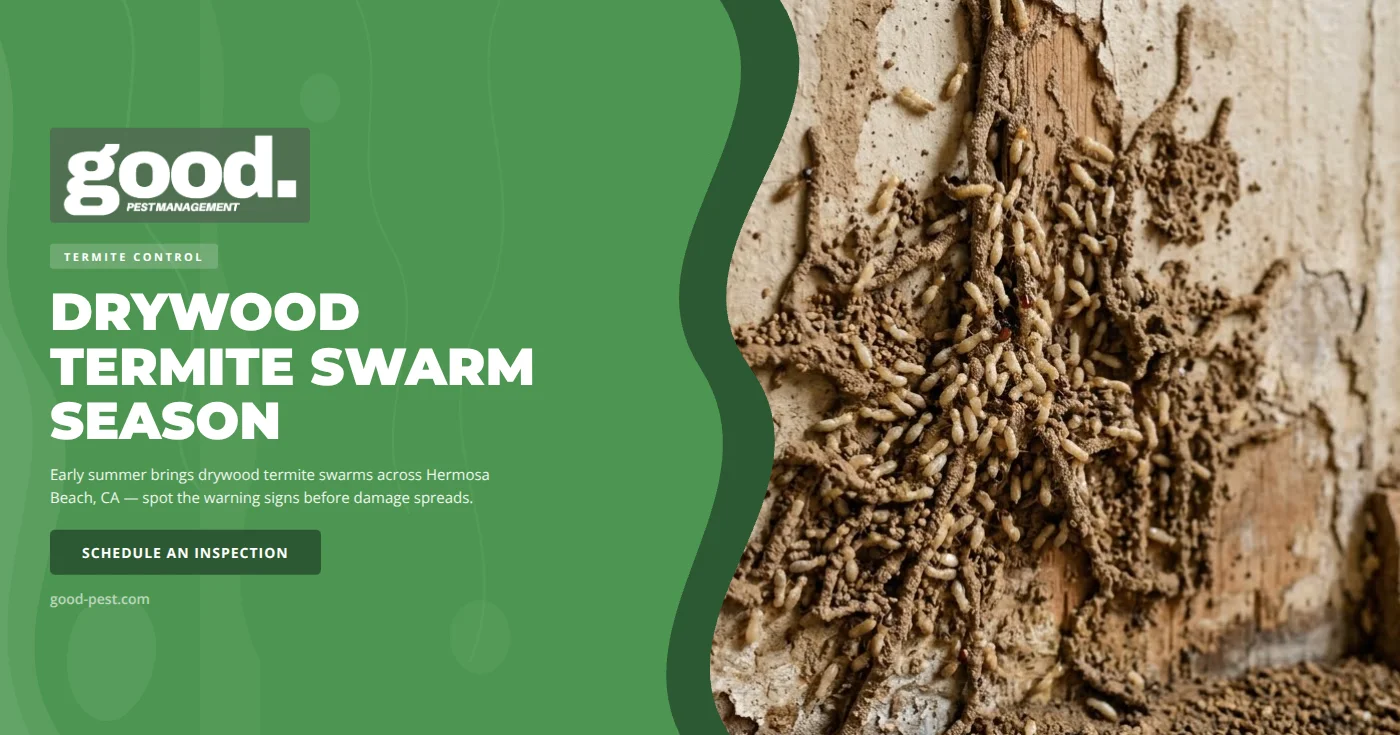
Early summer in Hermosa Beach is when the first warm, calm afternoons coax drywood termite swarmers out into the open. If you've noticed small piles of coarse, gritty sawdust along a windowsill, translucent wings on a tile floor, or pinhole openings in a fascia board, your home may be sitting at the leading edge of the season's first drywood termite swarm.
At Good Pest Management, we handle termite calls across Hermosa Beach, Manhattan Beach, Redondo Beach, and the broader South Bay year-round, and early summer is when the phone starts ringing about drywood activity. This guide covers why the season ramps up now, how drywood differs from subterranean termites, what a swarm looks like, the warning signs most homeowners miss, and when professional Termite Control is the right call. Termite control in Hermosa Beach, CA is about timing.
According to the UC Statewide Integrated Pest Management Program, the western drywood termite (Incisitermes minor) is the dominant drywood species along the California coast, and swarmers fly during daytime hours throughout summer and fall. In Hermosa Beach, the window opens earlier than most homeowners expect — mild marine air, June afternoons in the mid-70s, and the city's deep stock of older wood-framed homes give colonies everything they need to launch.
Unlike subterranean termites, which swarm on rainy spring days and return to the soil, drywood swarms in early summer kick off a months-long window that runs through October. Each successful pair that finds a crack in a fascia board or a worn window casing can establish a brand-new colony inside a Hermosa Beach home. Homeowners who get ahead of activity in June and July spend a fraction of what those waiting until tenting season in October and November spend on termite control in Hermosa Beach.
Hermosa Beach and the surrounding South Bay deal with both major termite groups, and the treatment plan changes sharply depending on which one is active. Per UC IPM, the two are distinguished by where they live, what they look like, and how their colonies behave:
In Hermosa Beach, the older homes on the Strand, bungalows on the Hill Section, and wood-clad townhomes in the East Hermosa walkstreets are textbook drywood territory — sun-exposed eaves, rafter tails, painted-over window casings, and decades-old fascia. Newer slab-on-grade construction near landscaped irrigation sees more subterranean pressure. Many homes have both, which is why a real inspection covers attic, eaves, crawlspace, and slab perimeter.
A drywood termite swarm is short, daytime, and easy to miss. Per UC IPM, swarmers fly during the day in summer and fall, usually on calm, warm afternoons. Here's what Hermosa Beach homeowners typically see:
If you've seen any of the above, bag a few intact swarmers and discarded wings and call for an inspection. A trained eye confirms drywood versus subterranean within seconds, and that distinction drives every choice that follows.
Drywood termites do not need soil — they fly to wood, drop their wings, and chew a small entry hole into a crack or knothole. Across our Hermosa Beach inspections, the same entry points come up again and again:
Long before you see a swarm, an established drywood colony leaves three signature signs around a Hermosa Beach home:
UC IPM offers a clean confirmation test: sweep up the pellets around a suspected kick-out hole, then check two or three days later. New frass means the colony is active. Either way, the next call should be to a licensed professional — drywood damage hides inside the wood until the surface gives way.
Add these clues to your watch list: paint that blisters or ripples for no obvious moisture reason, wood that sounds hollow when tapped, and door or window frames that suddenly stick. Two or three together, in the same part of the house, is a drywood infestation until proven otherwise.
Drywood termites extract moisture from the wood itself, so they survive in dry timber that would starve a subterranean colony. But coastal Hermosa Beach is not "dry" the way the desert interior is. Marine layer mornings, summer humidity in the 70 to 85 percent range, and the salt-laden breeze that softens exterior wood all push damage forward faster here than ten miles inland.
Coastal homes benefit from a proactive inspection every one to two years.
If any of the following apply, it's time to schedule a professional inspection rather than wait through the swarm season:
Our Good Pest Management technicians are licensed, insured, and members of the National Pest Management Association. A typical drywood inspection covers a full exterior wood survey, attic and rafter probe, garage and pergola review, and an interior walk-through with a moisture meter and flashlight. Where we find active colonies, treatment options range from localized injections and spot wood treatments to whole-structure approaches — we walk you through every choice with no pressure to escalate.
Per UC IPM, drywood termite products are restricted to licensed professional use, and DIY treatments are not recommended. Our products are eco-friendly, pet-friendly, and chosen with the well-being of families and pets in mind. Every service is backed by our 100% Satisfaction Guarantee.
Sawdust is irregular, fibrous, and clings together. Drywood frass is uniform, granular, and looks like coarse sand or ground pepper — each pellet is hard, oval, and has six ridged sides. If you find a pile of granular pellets directly below a pinhole, bag a sample and call for an inspection.
Western drywood termites along the California coast swarm during the daytime on warm afternoons from late spring through fall, with peak activity from summer into October. In Hermosa Beach, first swarms typically appear in June and continue through the season. Subterranean termites swarm earlier, on humid spring days — swarmers seen in March or April were likely subterranean.
Yes. We use eco-friendly, pet-friendly tools designed to be gentle around animals and children. Localized drywood treatments are injected directly into infested wood and sealed; for any broader application, we walk you through the protocol before any work begins.
No. An inspection is a non-invasive 45-to-90-minute visit using visual review, probing, and a moisture meter. Tenting is a treatment option for whole-structure infestations, not an inspection requirement. Many Hermosa Beach inspections find no activity, old inactive activity, or a small localized colony treatable without tenting at all.
Early summer is the window to get ahead of drywood termite activity in Hermosa Beach, CA. Our team is here to help — backed by our 100% Satisfaction Guarantee and a commitment to eco-friendly Termite Control for Hermosa Beach homes. Contact us today to schedule your inspection.