
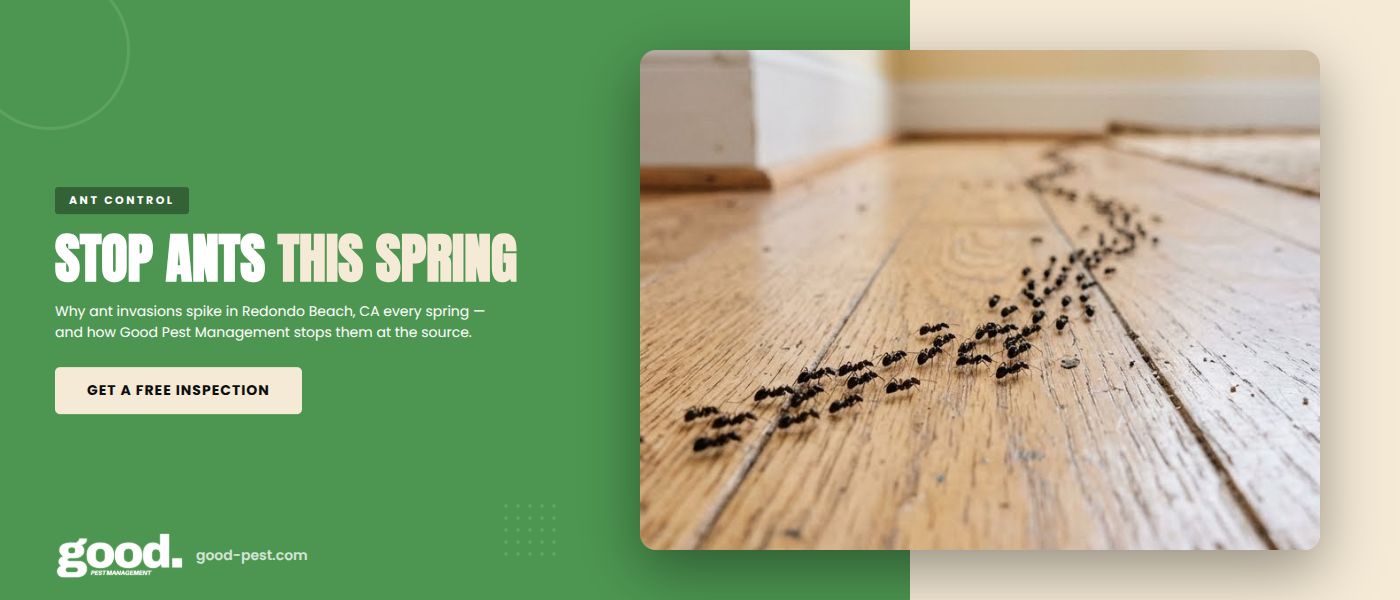
If you are looking for ant control in Redondo Beach, CA this spring, you are not alone. Every April, South Bay homeowners deal with the same sight: long trails of ants moving across kitchen counters, disappearing under baseboards, or converging on anything sweet left out. Spring ant invasions follow a predictable pattern — and a predictable problem has a real solution.
At Good Pest Management, we respond to more ant calls in April and May than at almost any other time of year. Warming temperatures, winter soil moisture, and rapid colony growth push ants from outdoor nests straight into homes across the South Bay. A small trail you ignore today can grow into a serious infestation by summer.
In this guide, we cover why spring is peak season for ant invasions, which species are most common in our area, how they get inside and where they hide, what happens when an infestation goes untreated, and how professional treatment eliminates the problem at its source.
Spring triggers a surge in ant activity across coastal Southern California every year. Three factors converge between March and May to push ants into homes in large numbers.
Colony expansion. Argentine ants — the most common household ant in the South Bay — begin rapid population growth in mid-March. Queens increase egg-laying, worker populations multiply, and forager ants fan out for food. According to the UC Riverside Center for Invasive Species Research, Argentine ants form vast interconnected super-colonies along California's coastline, with populations expanding from mid-spring through early fall. That expansion pushes foragers well beyond outdoor nesting areas and directly into homes.
Moisture displacement. The South Bay receives most of its annual rainfall between December and March. As winter rains saturate outdoor soil, ants in waterlogged nests move toward drier shelter — including wall voids, cabinets, and plumbing areas inside your home. Once they find a water source inside, they establish foraging trails that persist long after the rainy season ends.
Rising temperatures. Ant metabolism speeds up with heat. Workers that were sluggish in cooler months become highly active in April, pushing colony boundaries into new territory. The mild coastal microclimate means activity continues even on days when inland areas might slow down.
Identifying the species in your home matters. Different species have different behaviors and the right treatment depends on knowing what you are dealing with. Here are the three species we encounter most on spring service calls.
Argentine Ants are by far the most widespread household ant in coastal Southern California. Small — about 1/8 inch long — and light to dark brown, they travel in wide visible trails. Each colony maintains multiple queens, meaning killing surface workers does nothing to stop reproduction. When repellent products are applied, Argentine ant colonies often "bud," splitting into satellite colonies that spread the infestation further.
Odorous House Ants release a rotten coconut smell when crushed. They target kitchens and bathrooms, are drawn to sweet foods and moisture, and also maintain multiple queens — making surface treatments ineffective.
Carpenter Ants are less common but worth recognizing. They are noticeably larger — up to 1/2 inch — and dark brown or black. They excavate galleries in moist or damaged wood to build nesting spaces. Spotting large ants near windowsills or door frames warrants a professional inspection, since their presence often signals underlying moisture damage. For a detailed reference on California ant species, the UC Agriculture and Natural Resources IPM Program is a reliable source.
Ants do not need much of an opening. A gap as small as 1/16 of an inch is enough for most species. In South Bay homes — many with aging caulk and weatherstripping worn by coastal conditions — entry points are rarely hard to find.
Common entry points include:
Once inside, ants follow invisible scent trails laid down by scouts. These trails persist even after you wipe down the surface — which is why you see the same line of ants in the same spot day after day. Cleaning up visible workers does not erase the signal drawing more inside.
Common hiding spots include wall voids near plumbing, under kitchen cabinets, behind appliances, and inside insulation in crawl spaces. Scout ants can travel up to 100 feet from the colony, so the nest may be entirely outdoors while workers forage through your kitchen. This is why ant control must address both the interior activity and the exterior nesting zone to deliver lasting results.
A few ants on the counter can feel like a minor inconvenience. But ant infestations do not go away on their own — they grow. Here is what is at stake when activity goes unaddressed.
Food contamination. Ants travel through drains, garbage, and outdoor debris before reaching your kitchen surfaces. According to the National Pest Management Association (NPMA), ants are one of the leading causes of food contamination in residential settings, capable of carrying bacteria including Salmonella and E. coli.
Structural damage. If carpenter ants are present, ignoring them has real consequences. Over time, they excavate framing members, floor joists, and windowsills. In coastal homes that may already face humidity-related wood deterioration, carpenter ant damage can progress quickly and become costly to repair.
Rapid colony growth. Argentine ant colonies can reach hundreds of thousands of workers in a single season. A manageable trail in April can become a serious infestation by June if the root cause is not treated. Each week of delay gives the colony time to establish new satellite nests and additional entry routes.
Household well-being. Heavily infested kitchens affect everyone in the home. Children and pets interact with floor-level surfaces where ants travel constantly. Acting promptly protects your household rather than hoping a growing infestation resolves on its own.
Most homeowners try at least one store-bought solution before calling a professional. Understanding why those approaches fall short helps explain why professional ant control in Redondo Beach, CA delivers results that last.
Contact sprays kill workers on contact but act as repellents. Argentine ants reroute around the treated area — often finding a new entry point the same day. Repellent sprays can also trigger budding, where the colony splits into satellite nests inside your home to avoid the treated zone.
Consumer bait stations are a better option — workers carry bait back to the nest. But most consumer-grade formulations are too dilute to affect multiple queens, or they dry out before making a meaningful impact on a large colony.
Home remedies — vinegar, cinnamon, diatomaceous earth — may disrupt trails temporarily. They have no effect on the colony itself.
Professional ant control in Redondo Beach, CA works because licensed technicians identify the exact species and match the treatment to its biology. Professional-grade, non-repellent transfer products allow worker ants to carry active ingredients back to the colony undetected, exposing queens and collapsing reproduction from within. Our products are eco-friendly and designed with pets and families in mind from the start.
When you contact Good Pest Management, we start with a thorough inspection — not just a quick perimeter spray. Our process is built around finding and eliminating the colony, not just the workers you can see.
Inspection and identification. We trace foraging trails back toward their origin, identify entry points, and confirm the species present. Getting this step right determines everything that follows. A treatment designed for Argentine ants will not perform the same way against carpenter ants.
Targeted treatment. We apply professional-grade products at key interior entry points, along the perimeter, and around exterior nesting zones. Our formulations are designed to be carried back into the colony by worker ants, delivering thorough elimination rather than surface suppression. All products are eco-friendly and pet-friendly.
Exclusion recommendations. After treatment, we walk through conditions around your property contributing to ant pressure — moisture sources, vegetation contact, foundation gaps — and provide practical steps to reduce re-infestation.
Satisfaction guarantee. Our work is backed by a 100% Satisfaction Guarantee. If ants return between scheduled visits, we come back at no additional charge. As a licensed, insured, and NPMA member company, we also handle rodent control, termite treatment, and cockroach control across the South Bay.
Professional treatment addresses your current infestation. These habits help prevent the next one.
Eliminate food and water sources. Store pantry items in airtight containers. Wipe down counters after cooking and do not leave pet food out overnight. Fix dripping faucets and repair plumbing leaks promptly — even a slow drip under a sink can sustain a foraging trail year-round.
Seal entry points. Look for foundation cracks, gaps around pipes, and deteriorated weatherstripping. Silicone caulk handles most small gaps effectively. Replace worn weatherstripping on exterior doors and make sure crawl space vents have intact screening.
Manage the area near your foundation. Keep firewood stacked away from the house. Trim shrubs so they do not contact exterior walls and keep mulch at least six inches from the foundation.
Schedule preventive service. The most reliable way to keep ants out is a consistent professional pest management schedule. Quarterly treatments maintain a protective perimeter so that spring pressure never gains a foothold inside.
Spring triggers rapid colony expansion as temperatures rise and winter moisture pushes ants toward dry shelter. Argentine ant colonies grow dramatically between March and May. The mild coastal climate keeps colonies large through winter so they emerge in spring highly active. Rain events in late winter also displace soil nests, sending ants indoors in search of dry ground and food.
Lasting results require treating the colony, not just the visible trail. Store-bought sprays kill surface workers but leave the queens intact. Professional treatment uses non-repellent products that workers carry back to the colony, collapsing reproduction from within. Combined with entry point sealing, this is the approach that holds up over time.
Yes. We select products that are eco-friendly and pet-friendly — chosen with your pets and family's well-being in mind. All treatments are applied by licensed technicians, and we walk you through any precautions after each service visit.
We can typically schedule an inspection and initial treatment within one to two days. We serve the entire South Bay including Torrance, Palos Verdes, Carson, Lomita, and San Pedro.
A one-time treatment resolves most active infestations. Ongoing service is the most reliable way to prevent ants from returning. Outdoor ant pressure is continuous along the Southern California coast, and regular perimeter treatments maintain a barrier against new colonies establishing inside your home.
Spring ant invasions in the South Bay are predictable — but you do not have to live with them. At Good Pest Management, our licensed team delivers targeted ant control in Redondo Beach, CA that eliminates colonies at the source, backed by eco-friendly, pet-friendly products and a 100% Satisfaction Guarantee. With a 5.0-star rating and over 200 reviews from local families, we are the South Bay team you can count on. Contact us today to schedule your inspection and take back your home this spring.