
Every summer, our phones at Good Pest light up with the same call from Torrance homeowners: "I just found a black spider with a red mark in my garage — what do I do?" Black widow spider season in Southern California runs hard from late June through early October, and the South Bay is squarely in the heart of it. If you live in Torrance, CA, the odds are very good that you already share your property with at least one black widow — and once egg sacs hatch in midsummer, that one quietly multiplies.
This guide walks through everything we tell our Torrance customers about black widow spider control in Torrance: how to identify them, where they hide, what to do if you find one, and when to stop reaching for the can of spider spray and let our licensed local team handle it.
The Western black widow (Latrodectus hesperus) is a year-round resident of Southern California, but its population swells dramatically in summer. Female widows lay their egg sacs in late spring, and the spiderlings hatch out across June and July. By August, properties across Torrance, Carson, Gardena, Redondo Beach, and Palos Verdes are seeing the highest spider activity of the year.
The South Bay's microclimate makes our area especially comfortable for them. Black widows want what we have — dry summer days, cool overnight temperatures, and an abundance of low-light hiding places. The UC Statewide Integrated Pest Management Program notes that Western black widows thrive in exactly the kind of outdoor structures that surround most Torrance homes: garages, sheds, woodpiles, dense ground-cover landscaping, irrigation boxes, and the undersides of patio furniture.
The other piece of the seasonal pattern is human activity. Summer is when we open garage doors longer, leave shoes on the porch, dig through outdoor storage bins, and turn on the irrigation valves we have not touched since last fall. That is also when most bites happen — not because spiders become aggressive, but because we put our hands and feet where they have been hiding.
The good news is that black widows are one of the most distinctive spiders in California. The bad news is that several common South Bay spiders look similar enough to confuse, and homeowners often spray the wrong one — or miss the real widow entirely.
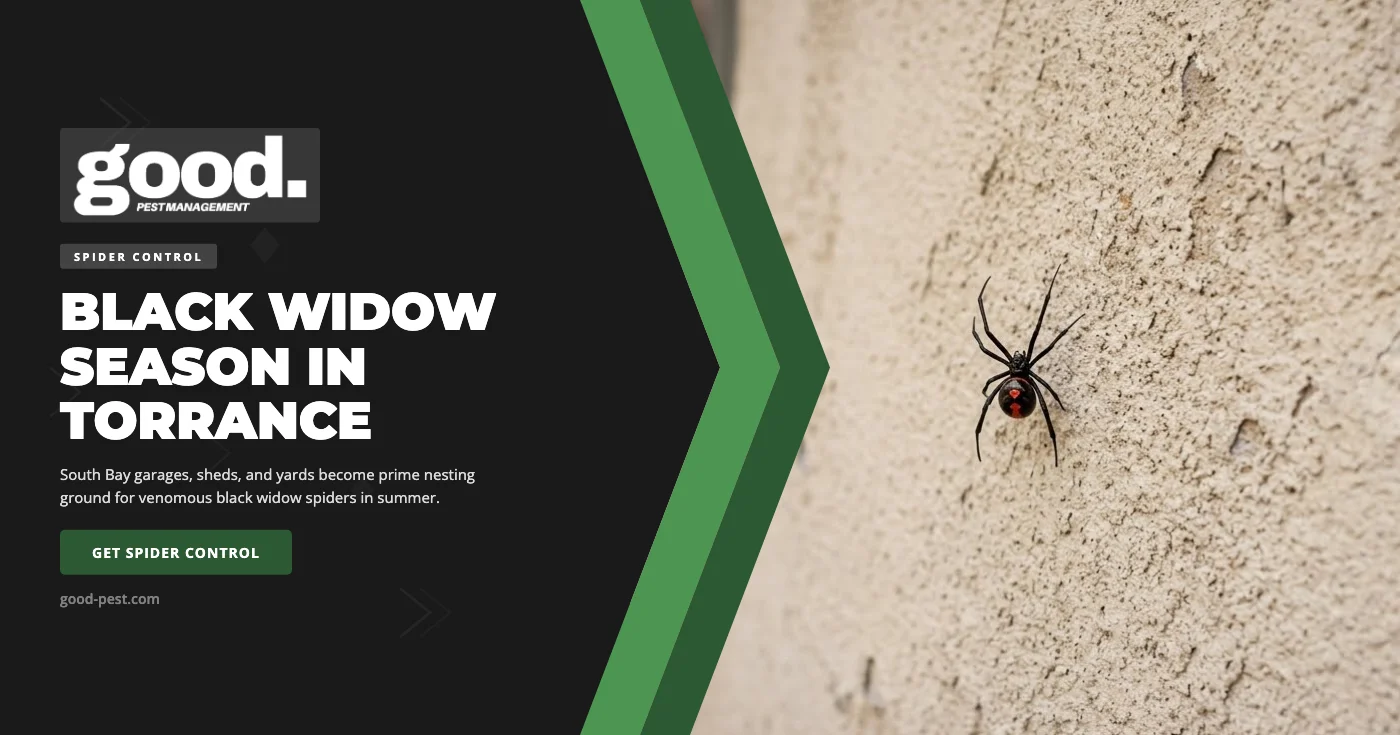
The adult female black widow is unmistakable once you know what to look for: a glossy, jet-black body roughly the size of a marble, long thin legs, and a bright red or orange hourglass marking on the underside of the abdomen. She is often hanging upside-down in a tangled, irregular web close to the ground.
The juvenile and male black widows are where confusion creeps in. Juveniles are lighter — tan, gray, or striped — and the hourglass may be incomplete or pale. Males are tiny and usually harmless, but their presence near a house means a female is somewhere nearby.
The look-alikes we see in Torrance most often:
If you are not certain what you are looking at, take a photo from a distance and send it to us. We identify a few of these every week for Torrance and South Bay homeowners.
Black widows are reclusive. They do not want to be in your living room. They want quiet, low-traffic, low-light spots with airflow and access to insect prey. Across years of spider control in Torrance, CA calls, the same hiding places show up over and over:
The web itself is a giveaway. A black widow web is a tangled, irregular jumble — not the symmetric wheel of a garden spider. It will be anchored to two or three surfaces and feel surprisingly strong when you brush it.
Black widow venom is a neurotoxin called latrotoxin, and gram for gram it is one of the most potent in the natural world. That said, the actual venom dose from a single bite is small — most healthy adults recover fully with medical care. The bigger concern is who gets bitten.
According to the U.S. Centers for Disease Control and Prevention, black widow bites require prompt medical evaluation — especially for children under 12, adults over 60, pregnant women, and anyone with underlying heart or respiratory conditions. Symptoms typically appear within 30 to 60 minutes of the bite and include severe muscle cramping (often in the abdomen, back, or chest), sweating, nausea, elevated blood pressure, and intense localized pain at the bite site.
If you or a family member is bitten in Torrance:
Do not apply heat. Do not use a tourniquet. Do not try to suck out or cut the venom. None of those interventions help, and several make things worse.
The single most effective long-term defense against black widows is making your property a less attractive place to live. We walk our Torrance customers through these five steps every season:
These steps reduce widow pressure significantly. They will not eliminate the population on a Torrance property by themselves — Southern California's climate keeps producing new widows year-round — but they make the difference between a manageable issue and a serious one.
Over-the-counter spider sprays have a real role for an occasional visible web in an out-of-the-way corner. Where they fall short is on established populations. Black widows are reclusive enough that the spider you see represents a fraction of the actual population, and a single can of contact spray does nothing to the egg sacs, the spiderlings inside the wall void, or the females hiding in the meter box.
Call us if you are seeing any of the following:
That last one matters more than people realize. A Torrance property should be a place your kids play in the backyard and your dog runs out of the garage door without anyone wondering about widows. When fear is changing how you live, it is time to bring in a local team that does this work every day. Our spider control service for Torrance and the South Bay is built specifically for the widow pressure our area faces.
Our licensed, eco-friendly approach is built around three steps:
Every Good Pest treatment is backed by our 100% satisfaction guarantee. If widows return between scheduled services, we come back and re-treat — no charge, no questions.
Are black widow spiders common in the South Bay? Yes — extremely so. Torrance, Carson, Gardena, Redondo Beach, Lomita, and the Palos Verdes Peninsula all see strong widow populations every summer. The South Bay climate is essentially ideal for them.
How do I identify a black widow in Southern California? Adult females are glossy black, marble-sized bodies with a bright red or orange hourglass on the underside of the abdomen. The web is irregular, low to the ground, and surprisingly strong. Juveniles are striped or tan and harder to identify — when in doubt, photograph from a distance and send the image to a licensed local pest control professional.
What should I do if I find a black widow in my Torrance garage? Do not try to capture it. Note the location, keep children and pets away, and either treat the immediate web with a contact spray from at least three feet away, or call us for a targeted treatment. If anyone has been bitten, get medical care immediately.
How often should I have my property treated for spiders? Most Torrance properties do best with a quarterly service through the year, stepped up to bi-monthly during peak summer widow season. Our team can build a plan that fits your property and budget after the first inspection.
Ready to take black widows off your worry list? Schedule an inspection through our spider pest control service and a Good Pest technician will walk your Torrance property, identify every active spot, and lay out a treatment plan tailored to South Bay conditions.