
The end of summer in Rolling Hills brings students home from college dorms, families back from long vacation road trips, and the last wave of guests filtering through Southern California's hotels. It also brings something less welcome. Every September, our team at Good Pest Management sees a spike in bed bug calls from across the South Bay, and Rolling Hills is not exempt. A single hitchhiker in a duffel bag, a suitcase, or a returned dorm mattress is all it takes to start a small population growing inside a home — and by the time bites appear on someone's arm or lower back, the population has usually been quietly reproducing for weeks. This guide walks Rolling Hills homeowners through what makes this time of year so risky, how to spot the earliest signs of an infestation, and what effective bed bug control in Rolling Hills, CA actually requires.
Bed bugs (Cimex lectularius) do not fly, jump, or spread on their own. They move exclusively by hitchhiking on the belongings of people traveling between infested locations and new, uninfested ones. The University of California Statewide Integrated Pest Management Program (UC IPM) notes that homeowners most commonly bring bed bugs into their homes through luggage, clothing, bedding, and used furniture, with hotel stays and time in high-turnover housing being the most common exposure points. Late summer and early fall are the busiest windows for those exposures.
The pattern our team sees in Rolling Hills every September looks something like this. A student flies home from an East Coast dorm and drops a duffel bag on a spare bedroom bed. A family returns from a July road trip through several hotel stops and leaves suitcases on the primary bedroom floor overnight. A visiting relative brings a rolling carry-on into a guest room. In each case, a handful of adult bed bugs or a small cluster of eggs stows away in a seam of the luggage, drops off into the nearest fabric-covered furniture, and settles in near the closest reliable food source — someone sleeping within a few feet.
Because adult bed bugs feed every five to seven days and can survive many months between meals, they don't need to establish themselves quickly to succeed. A population that starts with a single fertilized female can grow into hundreds of individuals within a season, since females lay 200 to 500 eggs over their lifetime. That's why the seasonal timing matters so much — the bed bugs that arrive with August travel produce their first noticeable bites in Rolling Hills homes right around back-to-school week, long after anyone would connect the two events.
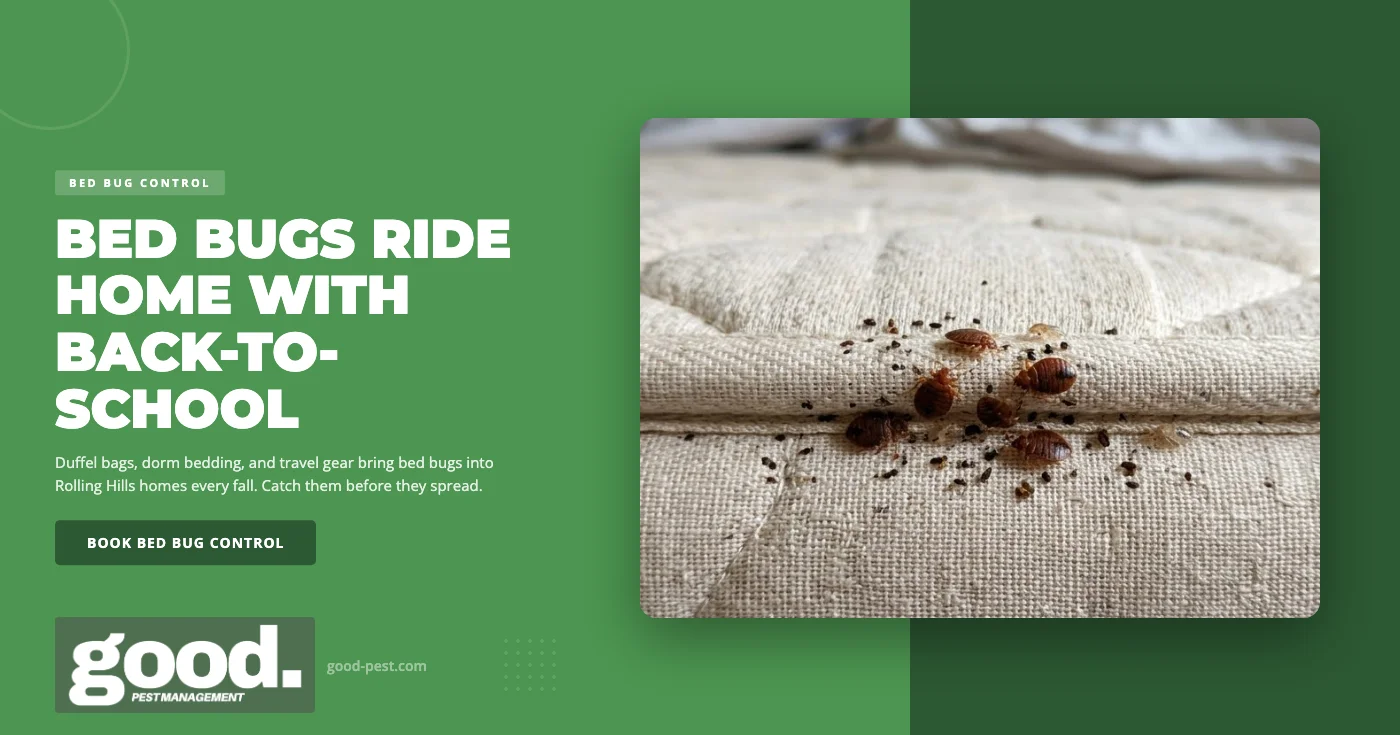
Because adult bed bugs are only about one-fifth of an inch long — roughly the size of an apple seed, flat, and reddish-brown — most Rolling Hills homeowners spot secondary signs before they spot the bugs themselves. Our team encourages residents to watch for these indicators, especially in the four to six weeks following any travel or the arrival of used furniture from another household:
The earlier those signs are noticed, the smaller the population still to eliminate. A single fertilized female caught within her first few weeks is a very different problem from a colony that has been reproducing quietly since July.
One of the persistent myths our team hears in Rolling Hills is that bed bugs only turn up in lower-income housing or budget hotels. That is not what the entomology or the industry data support. Reporting on hotel bed bug incidents this year has repeatedly documented sightings across every price tier, including five-star properties, and industry-tracked bed bug activity across the Los Angeles metro consistently ranks among the highest in the country. Bed bugs are drawn to warm-blooded hosts sleeping in one location for hours at a time; the finish quality of the surrounding room is irrelevant to them.
Rolling Hills, in particular, has several attributes that make it a natural fit for late-summer bed bug problems. Homes here tend to have multiple guest rooms and generous square footage, which gives a small population room to establish itself in an infrequently used bedroom before anyone notices. Household members travel widely for work, school, and vacation, and families in the community often welcome college-aged children returning from dorms up and down the West Coast every August. Any one of those touchpoints can introduce a bed bug population, and the size of the home often means the earliest bites appear in a rarely occupied guest room where the trail is easy to miss.
Cleanliness, in the household sense, has no meaningful relationship to whether bed bugs establish themselves. What matters is exposure — whether anyone brought luggage, secondhand furniture, or shared laundry into the home from another location where bed bugs were present. In Rolling Hills, exposure is a function of travel volume, not of housekeeping.
Between the first sighting and the arrival of a licensed technician, there are a handful of steps Rolling Hills homeowners can take to slow the spread. There are also several popular DIY approaches that make the problem worse, and it's worth being clear on the difference.
What actually helps:
What consistently fails:
Effective bed bug treatment across the South Bay generally falls into two approaches, and any reputable pest management company will explain both before quoting a Rolling Hills homeowner. The right choice depends on the size of the infestation, the layout of the home, and the household's tolerance for preparation work.
Heat treatment involves raising the temperature of a treated area to between 135°F and 145°F for six to eight hours — sustained long enough to kill every life stage from egg through adult. Bed bugs die within 90 minutes of continuous exposure at 118°F, and professional heat treatments overshoot that threshold by a comfortable margin. Heat is fast, thorough, and eliminates eggs — the life stage most resistant to product applications — in a single visit. The University of Minnesota Extension notes the tradeoff clearly: heat leaves no residual protection, so any bed bugs reintroduced after treatment can restart the population.
Targeted product applications use a combination of fast-acting contact treatments, residual products with weeks of activity, and applied dusts placed in wall voids and crevices where bed bugs shelter. This approach typically requires two to three visits spaced about two weeks apart, so freshly hatched nymphs are caught before they can reproduce. When performed correctly by a licensed technician, product-based treatment reaches parts of a Rolling Hills home that heat alone cannot fully penetrate — inside sofa frames, along carpet edges, and behind large built-in furniture.
In many South Bay homes, our team blends both approaches, focusing heat on beds and primary sleeping surfaces while applying targeted products around the perimeter of the affected rooms. This combined approach removes the active population quickly and leaves residual protection behind to catch any survivors or re-introductions.
Good Pest Management approaches every Rolling Hills bed bug call the same way: a careful inspection first, a written plan tailored to the property, and a follow-up commitment until the infestation is completely gone. Our technicians are licensed, insured, and trained on the specific behaviors and hiding patterns of the bed bug populations we encounter across the South Bay. Every treatment we perform is eco-friendly and designed with pets and family members in mind, and every job is backed by our 100% satisfaction guarantee.
The inspection stage matters more than most homeowners expect. Because bed bugs stay within a few feet of their host and hide in crevices most people never look inside, an experienced set of eyes on the property is often the difference between resolving the infestation in one round and chasing it around the house for months. Our team maps the affected areas, identifies likely source points, and confirms whether the problem is contained to one room or has already spread into shared living spaces.
From there, we build a treatment plan that fits the specific Rolling Hills property — the age of the home, the type of bedding and upholstery involved, and how the household uses the affected rooms. We schedule the appropriate combination of heat and targeted product applications, prepare the household for what to expect during each visit, and return for follow-up inspections to confirm the population has fully collapsed rather than simply retreated.
Q: How long after exposure will bed bug bites show up on my family?
A: The timing varies widely. Some people react to bites within a day or two, while others show no visible reaction at all despite active feeding. Because a fertilized female needs several weeks to produce a noticeable population, bites in Rolling Hills homes typically appear four to six weeks after the introducing event — luggage brought home from summer travel, a returning college student, or introduced used furniture. If you suspect an exposure, watch for the physical signs (dark spots, shed skins, live bugs on mattress seams) rather than relying on bites alone.
Q: Can I keep sleeping in the affected bedroom while treatment is scheduled?
A: You can, and our team usually recommends staying put rather than moving to a different room in the home. Moving to a guest room typically follows the human, and the bed bugs follow along in bedding, pajamas, and clothing. Continuing to sleep in the affected room — with interceptor cups under the bed legs and washed, dryer-heated bedding each night — keeps the population contained until we can eliminate it, and it protects the rest of the home from becoming a secondary infestation.
Q: Do we have to throw away our mattress after a bed bug infestation?
A: Almost never. Professionally treated mattresses can be preserved and encased in a bed-bug-proof cover after treatment, which extends their useful life for years. Discarding a mattress without treatment usually spreads bed bugs into other rooms during removal and drops the problem into your neighborhood, so our team recommends treatment first and disposal only if the mattress is physically damaged beyond use.
If you are seeing early signs of bed bugs in a Rolling Hills bedroom, guest room, or dorm-return space, don't wait to see whether the problem resolves on its own. Reach out to Good Pest Management to schedule an inspection, and let our local team handle bed bug control for your Rolling Hills home the right way — the first time.